
What Is Crypto Arbitrage?
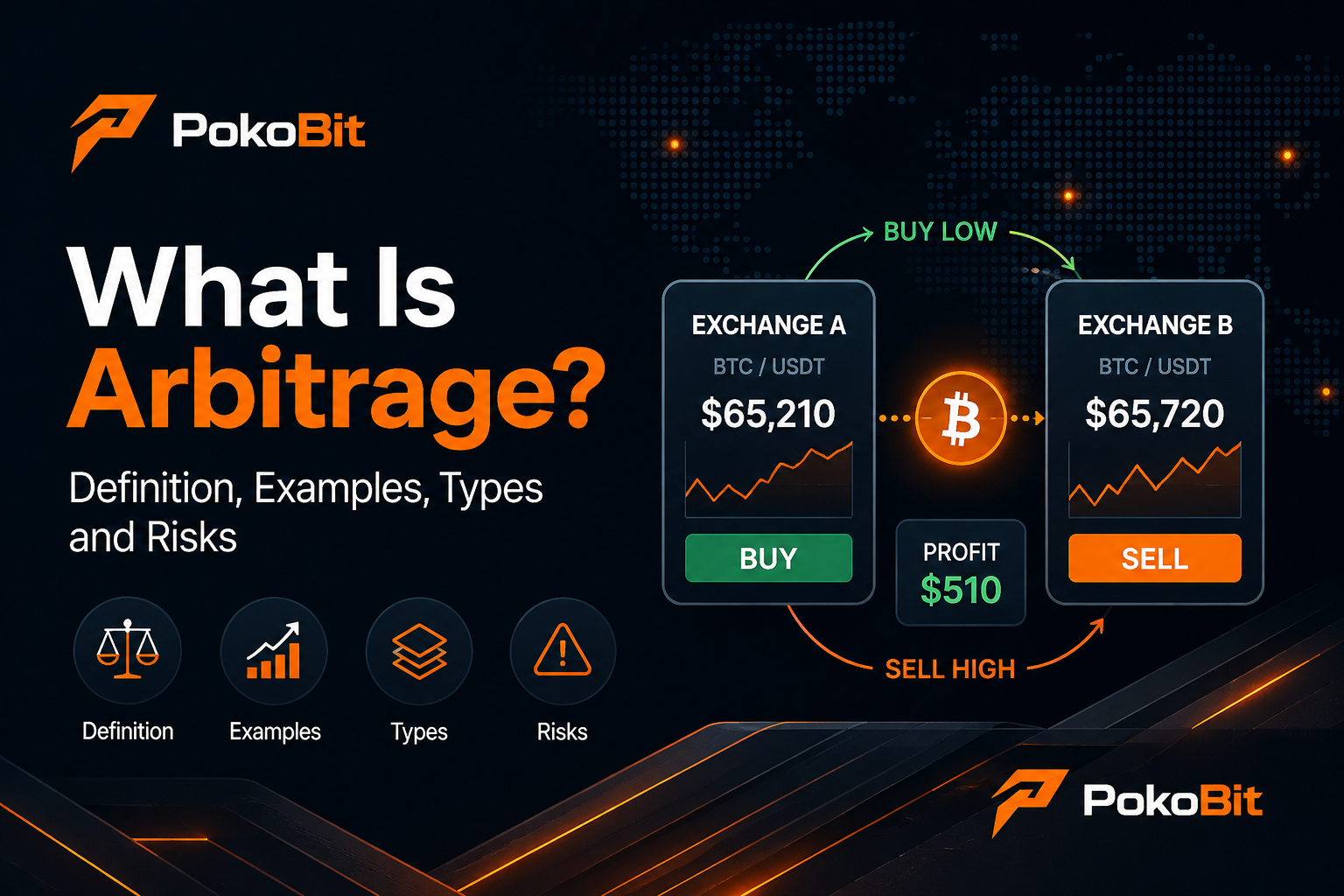
Crypto arbitrage is a trading strategy that attempts to take advantage of price differences for the same cryptocurrency across different markets or exchanges. A trader may buy an asset where it is priced lower and sell it where the price is higher, with the potential difference becoming the gross arbitrage spread.
The concept sounds simple, but finding a genuine opportunity requires more than spotting two different prices. Trading fees, withdrawal costs, slippage, liquidity, transfer delays, and rapidly changing prices can all affect whether an apparent spread is actually worth pursuing.
For beginners, the most important idea is this:
A price difference is an opportunity to investigate, not automatically a profit.
How Does Crypto Arbitrage Work?
Crypto arbitrage generally follows a simple process:
- Find a price difference
- Buy at the lower price
- Sell at the higher price
- Subtract all trading and transaction costs
- Determine whether a net opportunity remains
Consider a hypothetical example.
Suppose Bitcoin is showing:
| Exchange | BTC Price |
| Exchange A | $60,000 |
| Exchange B | $60,300 |
The apparent difference is $300 per BTC, or approximately 0.5%.
A trader could theoretically buy BTC on Exchange A and sell BTC on Exchange B.
But that $300 is not automatically the trader's profit.
Trading fees, withdrawal fees, network costs, bid-ask spreads, slippage and other execution costs could reduce or completely eliminate the difference.
This is why serious arbitrage analysis focuses on net spread, not simply the headline price difference.
Why Do Cryptocurrency Prices Differ Between Exchanges?
If cryptocurrency markets are global, why doesn't Bitcoin or another token have exactly the same price everywhere?
Because crypto does not trade through one central marketplace.
Each exchange has its own order books, traders, liquidity, trading volume and flow of orders. Differences in demand and supply can therefore cause temporary price discrepancies. (Coinbase)
Some factors that can contribute to price differences include:
- Different levels of liquidity
- Differences in buying and selling pressure
- Exchange-specific order books
- Regional demand
- Trading volume
- Network congestion
- Deposit and withdrawal conditions
- Delays between markets updating
- Market volatility
These differences can sometimes create the conditions that arbitrage traders monitor.
What Is a Simple Crypto Arbitrage Example?
Imagine that a cryptocurrency called ABC is trading at:
Exchange A: $10.00
Exchange B: $10.15
The gross price difference is $0.15 per token.
If a trader could buy 1,000 ABC tokens on Exchange A and sell 1,000 ABC tokens on Exchange B at those prices, the theoretical gross difference would be:
$0.15 × 1,000 = $150
However, the trader would still need to account for costs.
If total trading, transfer and execution costs were $80, the theoretical remaining amount would be:
$150 − $80 = $70
This illustrates an important principle of crypto arbitrage:
The spread you see is not necessarily the amount you keep.
What Are the Main Types of Crypto Arbitrage?
Crypto arbitrage is not limited to buying a cryptocurrency on one exchange and selling it on another.
1. Cross-Exchange Arbitrage
This is one of the easiest forms to understand.
A trader identifies the same cryptocurrency trading at different prices on two exchanges, then attempts to buy at the lower price and sell at the higher price.
For example:
Exchange A: ETH = $3,000
Exchange B: ETH = $3,030
The $30 difference represents the gross spread, before costs.
Cross-exchange arbitrage is particularly relevant when comparing multiple exchanges simultaneously. (Coinbase)
2. Triangular Arbitrage
Triangular arbitrage looks for pricing inconsistencies between three trading pairs, usually within the same exchange.
A simplified route could look like:
BTC → ETH → USDT → BTC
If the exchange rates between those pairs are temporarily misaligned, completing the three trades may theoretically produce more BTC than the trader started with.
The challenge is that the opportunity can disappear quickly, while three separate transactions also introduce trading fees and execution risk. (Binance)
3. Spot-Futures or Funding Arbitrage
Another strategy involves taking offsetting positions between spot and derivatives markets.
For example, a trader could hold an asset in the spot market while taking an opposing position in a perpetual futures market.
This is more advanced than basic cross-exchange arbitrage and introduces additional considerations such as funding rates, leverage and liquidation risk.
4. DEX Arbitrage
Decentralized exchanges can also produce price differences.
A token might temporarily trade at different prices across decentralized liquidity pools or between decentralized and centralized exchanges.
However, DEX arbitrage introduces additional considerations such as blockchain fees, network congestion, smart-contract risks and transaction execution.
Why Is Speed Important in Crypto Arbitrage?
Crypto markets operate around the clock, and arbitrage opportunities can change quickly.
Once traders identify a price discrepancy, buying pressure on the cheaper market and selling pressure on the more expensive market can push prices back toward alignment.
That means an opportunity visible on a screen now may not exist a few seconds later.
This is one reason arbitrage traders often use:
- Price scanners
- APIs
- Automated trading systems
- Bots
- Multi-exchange monitoring tools
The purpose of these tools is not to guarantee profitable trades. Instead, they can help traders identify and evaluate price discrepancies faster.
What Makes a Crypto Arbitrage Opportunity Potentially Profitable?
A useful way to think about an arbitrage opportunity is:
Net Opportunity = Gross Price Difference − Total Costs
Total costs can include:
- Trading fees
- Withdrawal fees
- Network or gas fees
- Bid-ask spread
- Slippage
- Transfer costs
- Other platform-specific charges
Liquidity matters too.
A displayed price may look attractive, but if there isn't enough liquidity at that price to execute the desired order, the actual execution price could be worse.
Therefore, a larger displayed spread does not automatically mean a better trade.
What Are the Risks of Crypto Arbitrage?
Crypto arbitrage is sometimes described as low-risk because it can reduce exposure to simply predicting whether an asset will rise or fall.
But crypto arbitrage is not risk-free.
Execution Risk
The price difference can disappear before both sides of the trade are completed.
Fee Risk
A small spread may be completely consumed by trading, withdrawal or network fees.
Liquidity Risk
There may not be enough buyers or sellers at the expected price.
Slippage
The final execution price can differ from the price initially displayed.
Transfer Risk
Moving assets between exchanges can take time, particularly when networks are congested.
Exchange Risk
Trading platforms can experience downtime, withdrawal restrictions or other operational problems.
Smart Contract Risk
DEX-based strategies can introduce additional technical and smart-contract risks.
These risks are why an arbitrage scanner should be viewed as an opportunity-discovery and analysis tool, rather than a machine that guarantees profits.
How Can Beginners Start Learning Crypto Arbitrage?
If you're new to crypto arbitrage, jumping straight into large trades isn't the best way to understand the strategy.
Start by learning how the process works.
Step 1: Understand spreads
Learn how to compare the price of the same asset across different markets.
Step 2: Learn the costs
Understand trading fees, withdrawal costs, network fees and slippage.
Step 3: Watch opportunities
Observe how quickly spreads appear and disappear.
Step 4: Compare exchanges
Understand the exchanges, trading pairs and liquidity involved before considering an actual trade.
Step 5: Start small if you eventually trade
If you decide to use real capital, start with an amount you can afford to lose and test your process carefully.
The objective at the beginning shouldn't be "How much can I make today?"
It should be:
"Do I understand why this opportunity exists, what it costs, and what could go wrong?"
How Can PokoBit Help With Crypto Arbitrage?
The difficult part of crypto arbitrage isn't knowing that one exchange can have a different price from another.
The difficult part is finding and evaluating those differences efficiently.
This is where an arbitrage scanner can become useful.
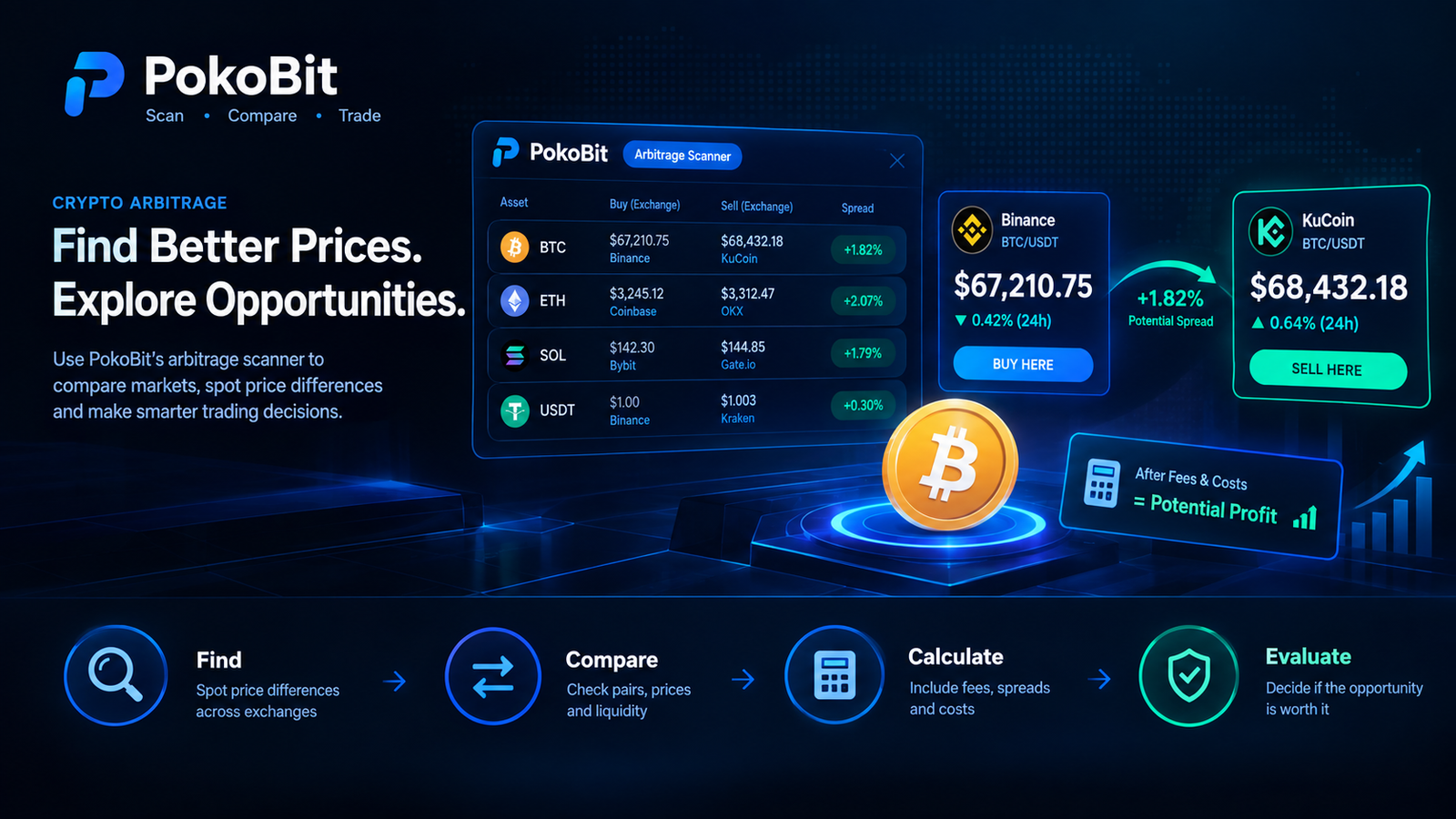
PokoBit is designed around monitoring crypto markets and identifying potential price discrepancies across supported exchanges, giving users a way to discover and examine arbitrage opportunities rather than manually checking exchanges one by one.
You can also explore PokoBit's supported exchange ecosystem here: Explore PokoBit Exchanges
For someone completely new to arbitrage, a sensible starting point is to observe the opportunities first, understand how the numbers change, and learn how fees and execution affect the theoretical spread before committing significant capital.
When you're ready to explore the platform:
Get Started With PokoBit
The goal isn't to chase every price difference. It's to understand which opportunities are worth investigating.
Final Takeaway
Crypto arbitrage is based on a straightforward idea: identify a price difference, buy where the asset is cheaper, sell where it is more expensive, and account for every cost involved.
The simplicity of the concept shouldn't be confused with simplicity of execution.
Successful arbitrage analysis requires attention to price, liquidity, fees, timing, exchange conditions and risk.
For beginners, the best first step is often education and observation.
Tools such as PokoBit can make it easier to monitor multiple markets and discover potential opportunities, while the responsibility for understanding the risks and deciding whether to trade remains with the user.