How to Arbitrage in Crypto: A Beginner's Guide
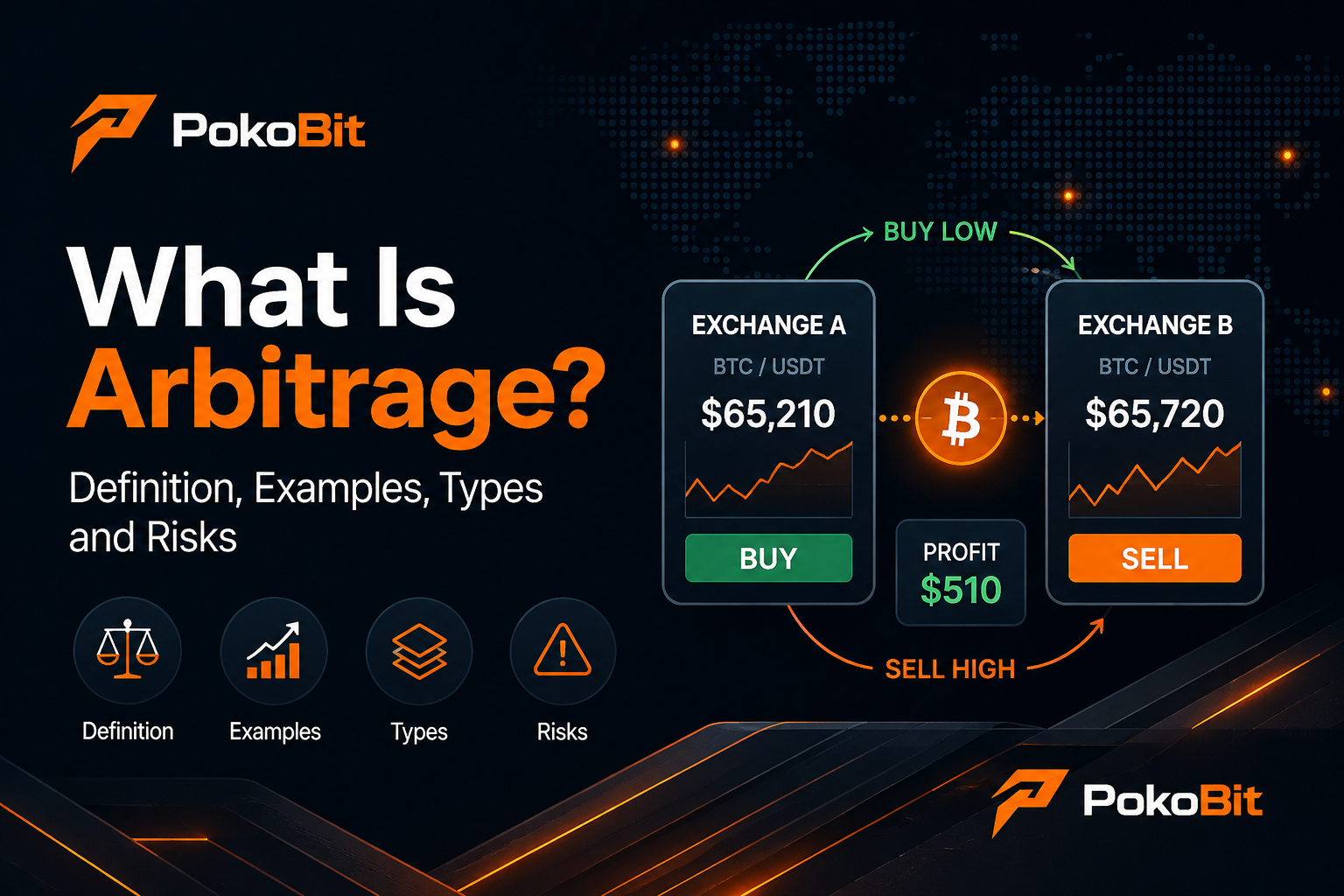
Seeing Bitcoin at one price on one exchange and a slightly different price somewhere else can raise an obvious question:
Could you buy it where it's cheaper and sell it where it's more expensive?
That's the basic idea behind crypto arbitrage.
But knowing the idea and actually executing an arbitrage trade are two different things. A price difference can disappear quickly, while trading fees, liquidity, slippage and transfer costs can turn an attractive-looking opportunity into an unprofitable one.
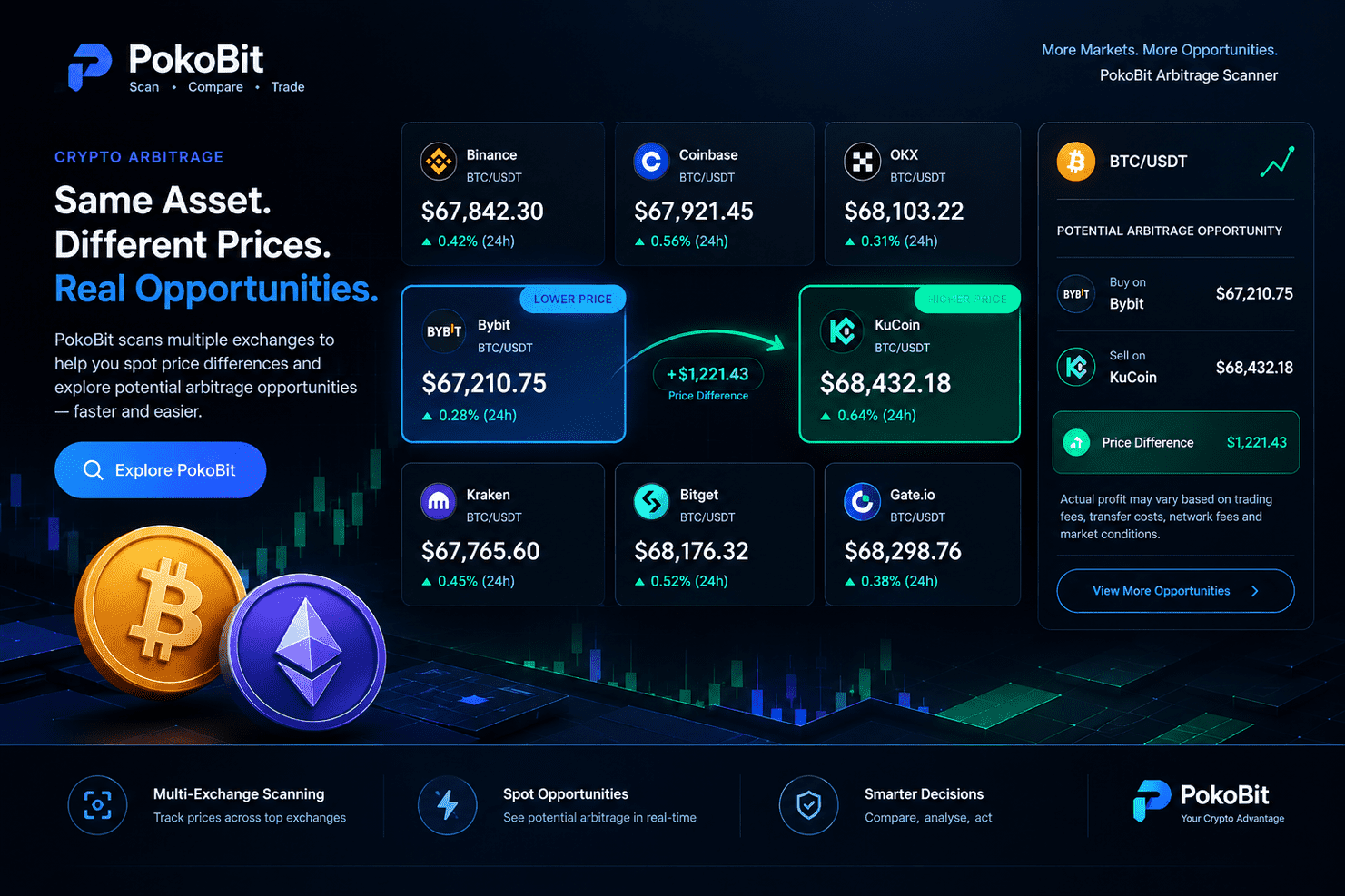
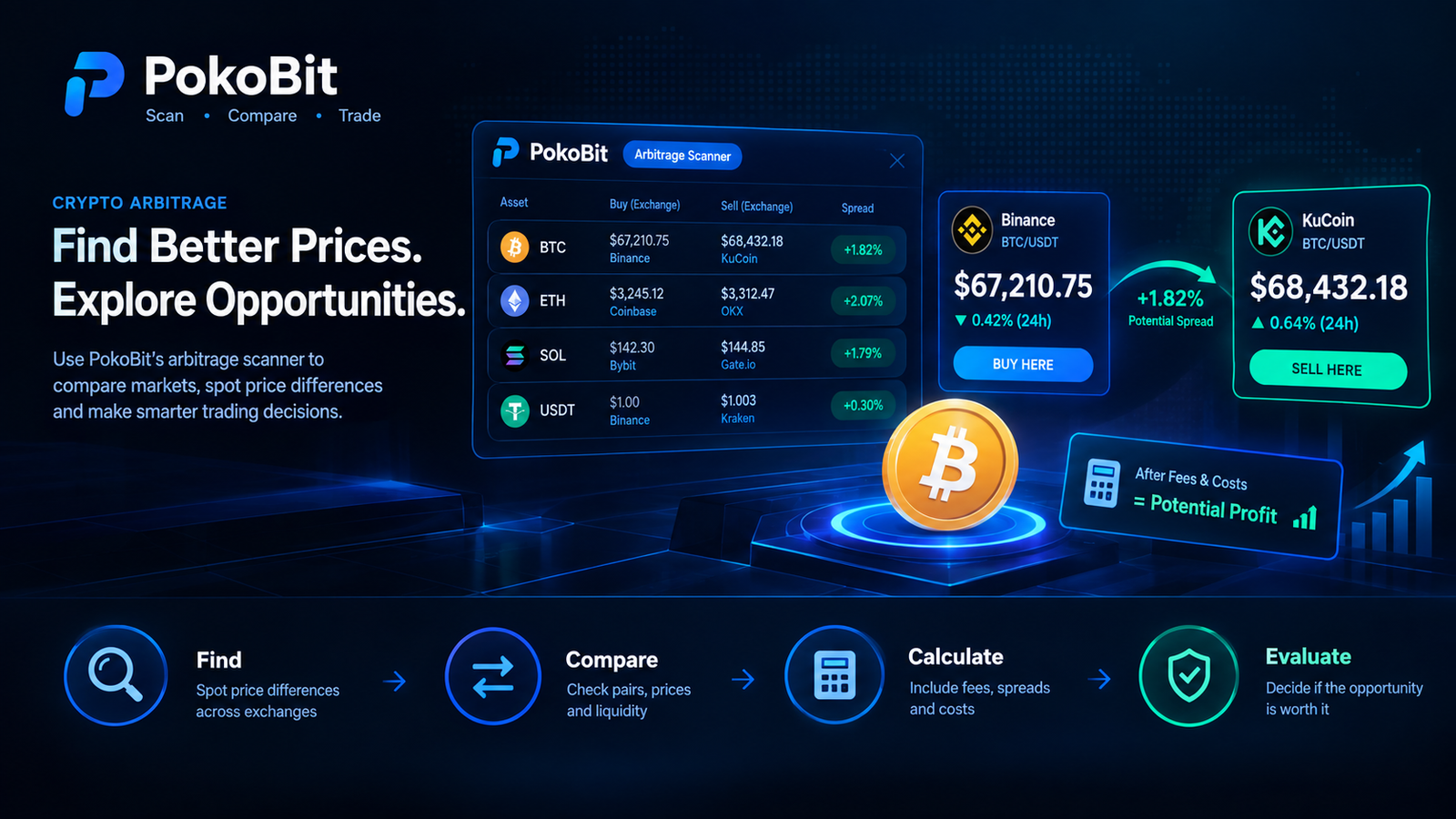
This guide walks through how to approach a crypto arbitrage trade step by step, including how to find an opportunity, check whether it is genuine, calculate the potential result and use an arbitrage scanner such as PokoBit to make opportunity discovery easier.
What Do You Need Before Starting Crypto Arbitrage?
Before looking for opportunities, you need a basic trading setup.
At minimum, you should understand:
- How cryptocurrency exchanges work
- How to place buy and sell orders
- Trading fees
- Bid and ask prices
- Liquidity
- Slippage
- The trading pairs you want to use
- Deposit and withdrawal conditions
You'll also need access to the relevant exchanges and enough capital to meet their trading requirements.
The important point is that having capital alone isn't enough.
You need to know what you're looking at before you start putting money into an arbitrage strategy.
Step 1: Find the Same Cryptocurrency at Different Prices
The first practical step is to compare prices.
Imagine you are monitoring BTC/USDT and see:
| Market | BTC/USDT Price |
| Exchange A | $67,210 |
| Exchange B | $67,850 |
At first glance, there is a $640 difference.
That immediately gives you something to investigate.
The basic idea would be:
Buy on Exchange A → Sell on Exchange B
But don't place the trade yet.
You've only discovered a potential opportunity.
Step 2: Confirm You're Comparing the Same Thing
This sounds obvious, but it's an important check.
Before calculating anything, confirm that you're comparing:
The same asset + the same trading conditions.
For example, make sure you're actually comparing:
BTC/USDT vs BTC/USDT
rather than accidentally comparing different pairs or different assets.
You should also check whether the displayed prices represent actual executable market prices rather than simply relying on a headline price shown by a platform.
A difference on a screen is only useful if you can potentially trade against it.
Step 3: Check the Order Book
This is where many beginners stop too early.
Suppose an exchange shows BTC at $67,210.
That doesn't necessarily mean you can buy a large amount of BTC at exactly $67,210.
The exchange has an order book containing available buyers and sellers at different prices.
If there isn't enough liquidity at the displayed price, your order could be filled across multiple price levels.
That changes your actual average purchase price.
The same applies when selling.
So before treating a spread as attractive, ask:
How much can actually be bought or sold at the prices I'm seeing?
This is where liquidity becomes important.
Step 4: Calculate the Gross Price Difference
Now calculate the basic spread.
Using our hypothetical example:
Exchange A: $67,210
Exchange B: $67,850
The difference is:
$67,850 − $67,210 = $640
As a percentage:
$640 ÷ $67,210 × 100 ≈ 0.95%
So the apparent spread is approximately 0.95%.
But again, this is a gross spread, not guaranteed profit.
There are still costs to consider.
Step 5: Calculate the Costs
This is arguably the most important step.
Suppose the apparent spread is 0.95%.
You now need to consider the costs associated with capturing it.
Depending on your setup, these could include:
- Trading fees
- Withdrawal fees
- Network fees
- Bid-ask spread
- Slippage
- Other transaction costs
Let's use a simplified hypothetical example.
You identify a $640 gross price difference.
After accounting for all relevant costs, suppose your estimated total cost is $250.
Your remaining theoretical difference would be:
$640 − $250 = $390
That's very different from saying:
"There's $640 profit available."
There isn't.
The $640 was simply the price difference before costs.
This distinction is critical when learning how to arbitrage in crypto.
Step 6: Check Whether the Opportunity Is Still There
Crypto markets move quickly.
An opportunity can change between the moment you identify it and the moment you attempt to trade it.
For example:
10:01:05
BTC difference = 0.95%
10:01:20
BTC difference = 0.60%
10:01:40
BTC difference = 0.20%
10:02:00
Difference disappears
This is why arbitrage isn't simply about finding price differences.
It's also about timing and execution.
Before acting, confirm that the prices you're using for your calculation are still available.
Step 7: Decide How You Will Execute the Trade
There are different ways an arbitrage strategy can be structured.
One simple approach is:
Buy BTC on the cheaper exchange → transfer BTC → sell on the more expensive exchange.
But the transfer itself introduces another variable.
The price could change while you're waiting for the transfer.
Another approach is to maintain balances on multiple exchanges and execute the buy and sell sides separately when an opportunity appears.
This can change the operational requirements of the strategy because you need funds available across the relevant platforms.
There isn't one universal setup that works for every trader or every arbitrage opportunity.
The important thing is to understand what has to happen between the initial buy and final sale.
Step 8: Account for Slippage
Slippage happens when the price at which your trade executes differs from the price you expected.
For example, you might see BTC at $67,210 and calculate your opportunity using that price.
But your actual purchase could be slightly higher because available liquidity at $67,210 isn't sufficient for your entire order.
If the selling price also moves against you, the combined effect can significantly reduce the original spread.
That's why experienced traders don't evaluate an opportunity based solely on the first number they see.
They consider the likely execution price.
Step 9: Use a Scanner to Find Opportunities Faster
You can manually compare exchanges.
The process might look like this:
Open Exchange A → check BTC → open Exchange B → check BTC → compare → check another asset → repeat.
This can become difficult when you're monitoring multiple exchanges and trading pairs.
An arbitrage scanner approaches the problem differently.
Instead of manually checking every market, the scanner can monitor supported exchanges and surface potential price differences for you to investigate.
This doesn't remove the need for analysis.
It simply makes the discovery stage more efficient.
PokoBit is designed around this type of arbitrage opportunity discovery, allowing users to monitor supported markets and explore potential price differences across exchanges.
You can learn more about what the platform offers through its Features section.
A Practical Example: Walking Through an Arbitrage Opportunity
Let's put everything together.
Imagine PokoBit identifies the following hypothetical BTC/USDT prices:
| Exchange A | Exchange B | |
| BTC Price | $67,210 | $67,850 |
| Apparent Difference | $640 | |
| Gross Spread | ~0.95% |
Your process should now be:
1. Confirm the asset
BTC/USDT is available on both markets.
2. Confirm the prices
Check whether the displayed prices are still available.
3. Check liquidity
Determine whether there is enough market depth for your intended trade size.
4. Calculate fees
Include trading and any applicable transaction costs.
5. Consider slippage
Ask whether your actual execution prices could be worse than the displayed prices.
6. Recalculate the net opportunity
Don't use the $640 headline difference as your expected profit.
7. Assess execution risk
Consider what could happen if one side executes but the other doesn't.
8. Decide
Only after these checks can you determine whether the opportunity is worth considering.
This is the difference between spotting an arbitrage spread and evaluating an arbitrage trade.
What Should You Check Before Every Arbitrage Trade?
A simple checklist can help prevent you from focusing too heavily on the headline spread.
Crypto Arbitrage Checklist
Asset
- Is it the same cryptocurrency?
- Is the trading pair correct?
Price
- Is the price difference still present?
- Are you using an executable price?
Liquidity
- Is there enough liquidity for your trade?
- Could your order cause significant slippage?
Costs
- Have you included trading fees?
- Have you included network or withdrawal costs where applicable?
Execution
- Can both sides of the trade be executed?
- Could a transfer delay affect the opportunity?
Risk
- What happens if the spread disappears?
- What happens if one side of the trade fails?
If you cannot answer these questions, you probably haven't finished evaluating the opportunity.
What Can Go Wrong With Crypto Arbitrage?
Imagine you find what appears to be a 1.2% spread.
You think you've found a strong opportunity.
Then reality changes the calculation.
The price moves by 0.4%.
Slippage costs another 0.3%.
Trading fees take another portion.
A network or transfer cost adds another expense.
Suddenly, your 1.2% headline spread may have very little left after costs.
This is why crypto arbitrage should never be presented as guaranteed or effortless profit.
The strategy depends on successfully identifying and executing opportunities while controlling the costs and risks involved.
Manual Arbitrage vs Using an Arbitrage Scanner
For someone learning crypto arbitrage, the difference is easy to understand.
| Manual Monitoring | Arbitrage Scanner |
| Check exchanges individually | Monitor multiple supported markets |
| Compare prices manually | Surface potential price differences |
| Time-consuming at scale | Faster opportunity discovery |
| Easy to miss changing spreads | Easier to monitor many markets |
| Requires constant checking | Reduces repetitive checking |
A scanner doesn't replace judgment.
It helps reduce the amount of manual work involved in finding where to look.
That's where a platform like PokoBit can become useful.
Instead of spending your time asking:
"Which exchanges have a price difference right now?"
you can spend more time asking:
"Is this particular opportunity actually worth considering?"
How Should a Beginner Start With PokoBit?
If you're new to crypto arbitrage, don't make your first objective finding the biggest percentage on a scanner.
Make your first objective understanding what you're seeing.
Start by exploring the opportunities available on PokoBit.
Pick one.
Then investigate:
What asset is this?
Which exchanges are involved?
What is the price difference?
What would the spread look like after fees?
Is there enough liquidity?
How quickly does the opportunity change?
This gives you a practical way to learn the mechanics of arbitrage before committing significant capital.
Once you understand the process and are comfortable with the risks, you can explore the platform further and decide whether it fits your trading approach.
Start with the numbers. Understand the opportunity. Then decide whether to trade.
Frequently Asked Questions
Can I arbitrage crypto as a beginner?
Yes, you can learn and explore crypto arbitrage as a beginner. However, you should understand fees, liquidity, slippage, execution and exchange risks before committing meaningful capital.
How much money do I need to arbitrage crypto?
There is no universal amount that guarantees a viable strategy. The amount you need depends on the exchanges, assets, minimum order sizes, fees, liquidity and strategy you're using.
Do I need multiple exchange accounts for crypto arbitrage?
Some arbitrage strategies involve multiple exchanges, while others can be performed within a single exchange using different trading pairs. Your setup depends on the type of arbitrage strategy you're using.
Is a crypto arbitrage scanner necessary?
No. You can manually compare prices across exchanges. However, a scanner can make opportunity discovery more efficient by monitoring multiple supported markets instead of requiring you to check each exchange individually.
Does finding a crypto arbitrage opportunity mean I will make money?
No. A displayed price difference is only a potential opportunity. Fees, slippage, liquidity, price movements and execution problems can reduce or eliminate the potential return.
Final Thoughts
Learning how to arbitrage in crypto isn't about memorizing one simple formula.
It's about developing a process.
Find the difference.
Verify the prices.
Check liquidity.
Calculate the costs.
Consider execution.
Evaluate the risk.
Then decide.
That process is what separates simply seeing a price difference from properly evaluating an arbitrage opportunity.
And while you can manually search through exchanges, an arbitrage scanner can make the discovery process much easier.
For beginners, PokoBit can be a useful place to start exploring that process. Instead of immediately focusing on how much you could make, use the platform to understand how opportunities appear, how spreads change and what needs to be checked before a trade is considered.
The goal isn't to chase every spread you see. It's to learn how to recognize the difference between an interesting price difference and an opportunity that may actually be worth investigating.