What Is Arbitrage? Definition, Examples, Types and Risks
Arbitrage is a strategy that seeks to take advantage of a price difference for the same, or economically equivalent, asset in different markets. In a simple example, if an asset can be bought for $100 in one market and sold for $102 in another, the $2 difference represents a potential arbitrage opportunity before fees and other costs.
Arbitrage exists because prices do not always adjust at exactly the same time across markets. Traders and financial institutions may attempt to identify these differences and execute trades that capture the price gap.
What Does Arbitrage Mean?
Arbitrage refers to taking advantage of a difference in prices for the same or closely related asset across markets.
The basic idea is:
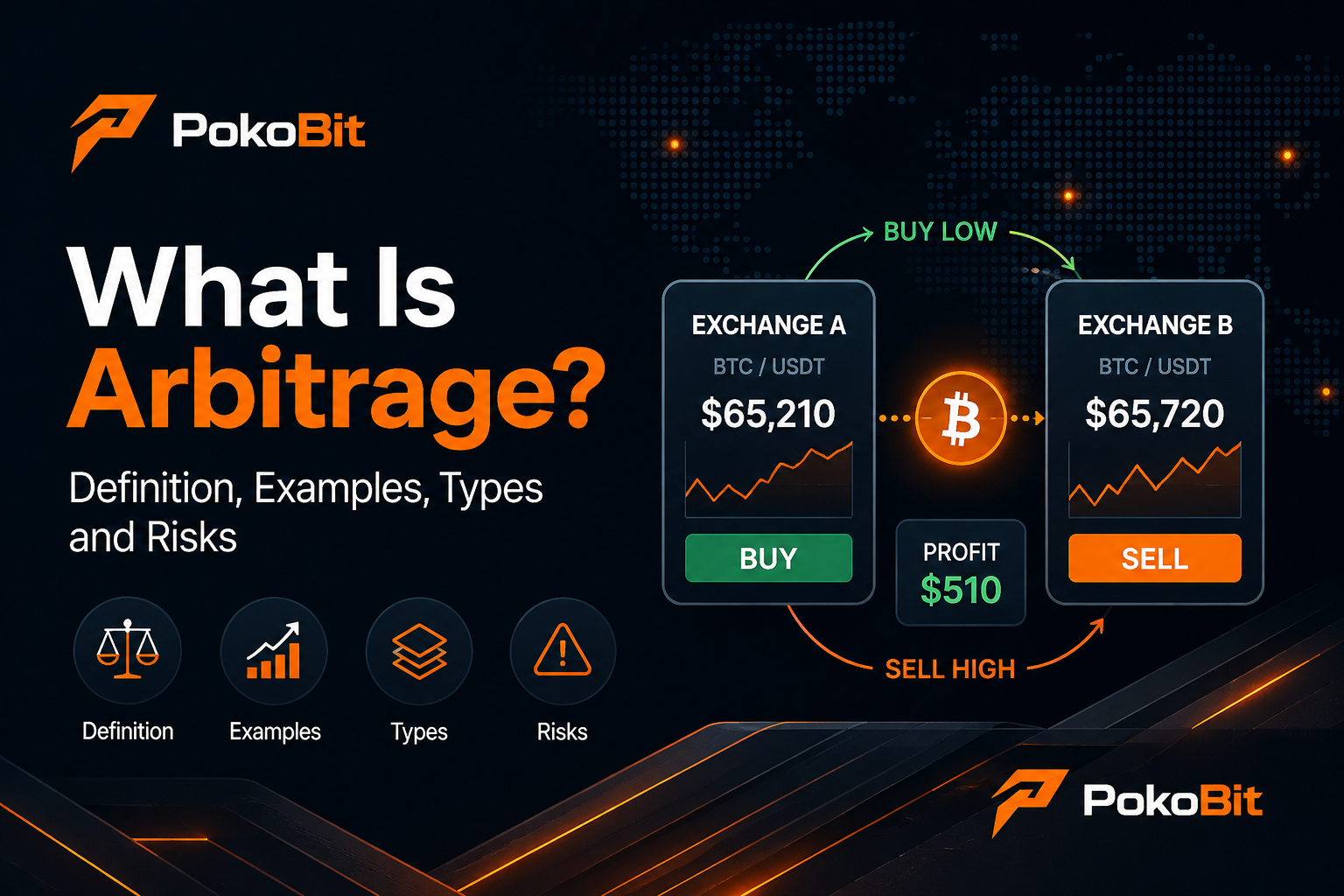
Buy where the price is lower → sell where the price is higher → capture the difference.
However, the difference between two prices is not automatically a profit.
A trader may have to account for:
- Trading fees
- Withdrawal or transfer fees
- Bid-ask spreads
- Slippage
- Taxes
- Transfer delays
- Liquidity
- Execution risk
- Market movements
This is particularly important in fast-moving markets such as cryptocurrency, where a price difference can disappear before both sides of a trade are completed.
How Does Arbitrage Work?
A basic arbitrage process involves identifying a price discrepancy and determining whether the difference is large enough to potentially cover the costs of executing the trades.
Consider a simplified example.
Suppose Bitcoin is quoted at:
| Market | Bitcoin Price |
| Exchange A | $100,000 |
| Exchange B | $100,500 |
The apparent price difference is $500.
A trader could theoretically buy Bitcoin on Exchange A and sell Bitcoin on Exchange B.
However, the $500 difference is not necessarily the trader's actual profit.
If the combined trading fees, withdrawal costs, spread, slippage and other expenses amount to $350, the remaining difference would be only $150.
If those costs exceed $500, the apparent arbitrage opportunity may not be profitable at all.
This is why price difference and arbitrage profitability are not the same thing.
Why Do Arbitrage Opportunities Exist?
If markets are constantly competing to discover the correct price of an asset, why do price differences exist?
Several factors can contribute.
Different levels of liquidity
An asset may have significantly more buyers and sellers on one market than another.
A highly liquid market can adjust to new information quickly, while a less liquid market may temporarily display a different price.
Differences in supply and demand
Buying pressure can push an asset's price higher on one exchange while another market adjusts more slowly.
Market fragmentation
Financial assets can trade across many venues rather than one centralized marketplace.
Cryptocurrency is a particularly clear example because the same asset can trade across numerous centralized and decentralized markets.
Transfer and settlement limitations
Moving an asset between markets may take time.
During that period, prices can change.
Market inefficiencies
Markets are not perfectly synchronized.
Differences in technology, liquidity, participants, trading activity and information flow can create temporary price discrepancies.
What Are the Main Types of Arbitrage?
Arbitrage can take several forms depending on the markets and assets involved.
Spatial arbitrage
Spatial arbitrage involves buying an asset in one market and selling the same asset in another market where it has a higher price.
This is one of the easiest forms of arbitrage to understand.
For example:
Market A: Asset = $100
Market B: Asset = $103
The theoretical price difference is $3.
Crypto traders may encounter similar situations when comparing prices across different cryptocurrency exchanges.
Triangular arbitrage
Triangular arbitrage involves three related trading pairs rather than simply buying and selling the same asset across two markets.
For example, a trader may move through a sequence such as:
BTC → ETH → USDT → BTC
If the exchange rates between those three markets become temporarily misaligned, the sequence may produce more BTC at the end than the trader started with.
Triangular arbitrage can be more complicated because the opportunity depends on the relationship between multiple trading pairs.
Statistical arbitrage
Statistical arbitrage uses quantitative models and historical relationships between assets to identify potential pricing inefficiencies.
Unlike simple price-difference arbitrage, statistical arbitrage can involve assumptions about how prices behave over time.
It therefore introduces additional model and market risks.
Merger arbitrage
Merger arbitrage is associated with corporate transactions.
When a company announces an acquisition or merger, the target company's shares may trade at a price below the proposed acquisition price.
Some investors attempt to profit from the difference if they believe the transaction will be completed.
However, the transaction may fail, meaning the expected price convergence may not occur.
What Is Crypto Arbitrage?
Crypto arbitrage applies the same general principle to cryptocurrency markets.
Because cryptocurrencies can trade across multiple exchanges and markets, the same asset can sometimes have different prices at different venues.
For example:
| Exchange | BTC Price |
| Exchange A | $100,000 |
| Exchange B | $100,400 |
| Apparent difference | $400 |
A trader may investigate whether buying at the lower price and selling at the higher price could produce a positive result after accounting for all transaction costs.
Crypto arbitrage can involve:
- Cross-exchange arbitrage
- Triangular arbitrage
- DEX-to-DEX arbitrage
- CEX-to-DEX arbitrage
- Stablecoin arbitrage
- Other market-specific strategies
The specific opportunity depends on available liquidity, execution speed, fees, market conditions and the assets involved.
Is Arbitrage Risk-Free?
No. Arbitrage should not automatically be considered risk-free.
The traditional idea of arbitrage often involves attempting to capture a price discrepancy with limited exposure to market direction. In real-world markets, however, execution introduces risks.
These can include:
Execution risk
The price may change between the time one trade executes and the time another trade is completed.
Liquidity risk
There may not be enough buyers or sellers at the displayed price to execute the desired trade size.
Fee risk
An apparently attractive price difference may disappear after trading, withdrawal and other costs are included.
Transfer risk
Moving cryptocurrency between exchanges can take time, and the opportunity may disappear during the transfer.
Exchange risk
An exchange or trading venue may experience downtime, withdrawal restrictions, technical problems or other operational issues.
Smart contract risk
Strategies involving decentralized finance can introduce additional risks related to smart contracts and blockchain infrastructure.
Market risk
Prices can move rapidly, particularly in volatile markets.
For these reasons, an arbitrage opportunity should be evaluated based on its net economics, not simply the visible price difference.
What Is the Difference Between an Arbitrage Opportunity and a Profitable Trade?
This distinction is important.
An arbitrage opportunity is a price discrepancy that may be exploitable.
A profitable arbitrage trade is an opportunity that remains positive after all relevant costs and execution factors are considered.
A simplified calculation is:
Potential net result = Price difference − trading costs − transfer costs − slippage − other applicable costs
For example:
- Price difference: $500
- Trading costs: $150
- Transfer costs: $50
- Slippage: $100
Potential remaining difference:
$500 − $150 − $50 − $100 = $200
Even this simplified calculation does not guarantee that the trade will actually produce $200 because prices and execution conditions can change.
This is why arbitrage analysis requires more than simply looking for the biggest percentage price difference.
How Do Traders Find Arbitrage Opportunities?
Historically, traders could compare prices manually across different markets.
That becomes increasingly difficult as the number of exchanges, assets and trading pairs increases.
Modern arbitrage workflows can use:
- Exchange APIs
- Market-data feeds
- Trading bots
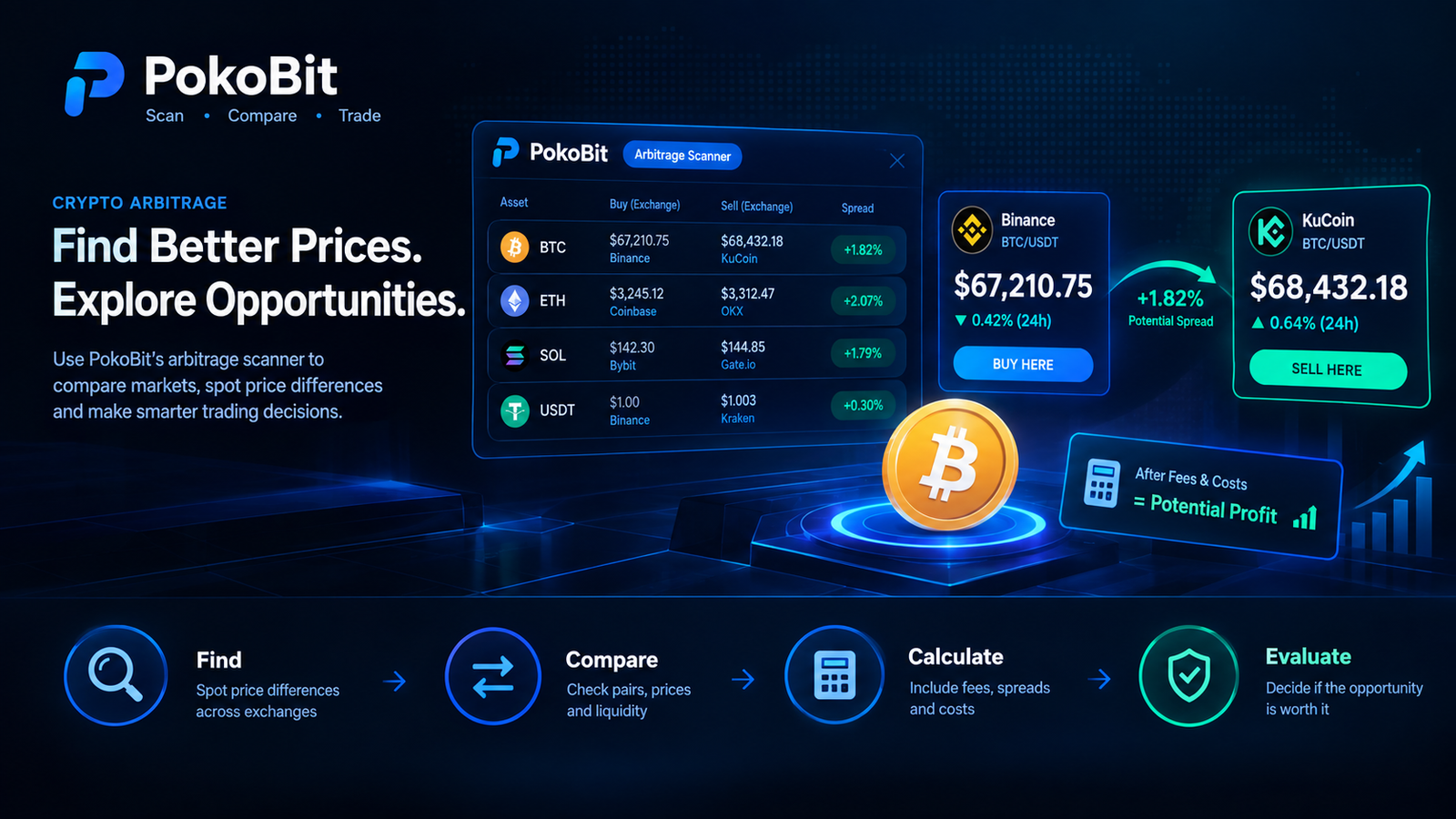
- Arbitrage scanners
- Automated monitoring systems
- Custom scripts
- Spreadsheets and analytical tools
The purpose of these tools is generally to reduce the amount of manual monitoring required and help traders identify potential price discrepancies more efficiently.
However, identifying an opportunity is only one part of the process.
A trader still needs to evaluate whether the opportunity is executable and whether the potential return justifies the associated costs and risks.
Why Is Arbitrage Important in Financial Markets?
Arbitrage is not only about individual traders attempting to profit from price differences.
Arbitrage activity can also contribute to market efficiency.
When traders notice that an asset is significantly cheaper in one market than another, buying pressure in the cheaper market and selling pressure in the more expensive market can push the prices closer together.
In this sense, arbitrageurs can help reduce temporary price discrepancies between connected markets.
The process is part of the broader mechanism through which markets discover prices.
Is Arbitrage Still Relevant in Cryptocurrency?
Yes, price discrepancies can still occur in fragmented cryptocurrency markets, but the environment is highly competitive.
Technology has made it easier to monitor prices across many markets, meaning opportunities can disappear quickly.
At the same time, crypto markets continue to have differences in:
- Liquidity
- Trading volume
- Market participants
- Exchange infrastructure
- Trading fees
- Geographic availability
- Blockchain networks
- Settlement mechanisms
These differences can create situations where prices temporarily diverge.
However, the existence of a price difference does not mean that every opportunity is practical or profitable.
What Should You Check Before Considering an Arbitrage Opportunity?
Before acting on an apparent opportunity, traders should consider:
- Price difference — How large is the spread?
- Trading fees — What will each transaction cost?
- Liquidity — Can the required amount actually be traded?
- Slippage — What price will the trade realistically execute at?
- Withdrawal costs — Are there transfer fees?
- Transfer time — How quickly can assets move?
- Exchange restrictions — Are deposits and withdrawals functioning normally?
- Market volatility — Could the price change before execution?
- Capital requirements — How much capital is required on each venue?
- Net result — Does the opportunity remain attractive after costs?
The bigger the apparent spread, the more important it is to investigate why the spread exists.
Frequently Asked Questions
What is arbitrage in simple terms?
Arbitrage is the practice of attempting to benefit from a price difference for the same or related asset in different markets. A basic example is buying at a lower price in one market and selling at a higher price in another.
Is arbitrage trading legal?
The legality of arbitrage depends on the jurisdiction, market, assets involved and applicable regulations. Traders should understand the laws and rules that apply to their location and the platforms they use.
Is arbitrage risk-free?
No. While arbitrage strategies can attempt to reduce exposure to broad market direction, execution, liquidity, fees, transfer delays, platform issues and other risks can affect the outcome.
What is crypto arbitrage?
Crypto arbitrage is the application of arbitrage strategies to cryptocurrency markets. It can involve identifying price differences for the same cryptocurrency across exchanges or exploiting relationships between different crypto trading pairs.
Can arbitrage be profitable?
An arbitrage opportunity can potentially produce a positive result when the price difference is greater than the costs and risks involved in executing the trades. However, profitability is not guaranteed, and a displayed price difference should not be treated as guaranteed profit.