Crypto Funding Rate Arbitrage Explained
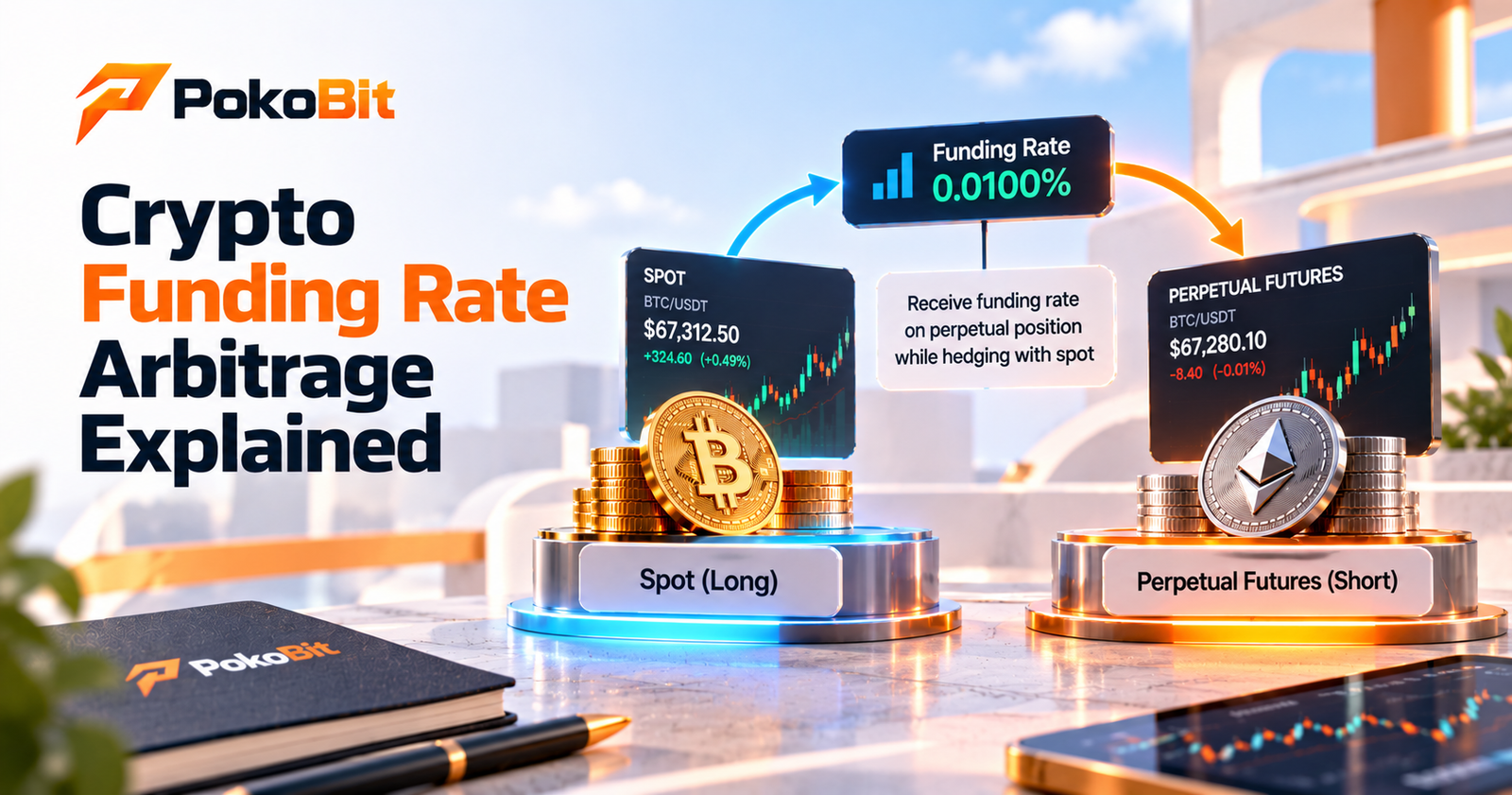
Crypto funding rate arbitrage is a strategy that attempts to earn from funding payments in perpetual futures markets while reducing exposure to the cryptocurrency's price direction.
The basic idea is to hold opposing positions in the spot and perpetual futures markets. A common setup involves buying the cryptocurrency in the spot market while shorting an equivalent amount on a perpetual futures contract.
When the funding rate is positive, traders holding long positions generally pay those holding short positions. This can create an opportunity for a hedged trader to receive funding payments.
However, funding rate arbitrage is not guaranteed profit. Funding rates change, trading fees apply, and the spot and futures positions may not perfectly offset each other.
For a broader introduction to the strategy, see What Is Spot-Futures Arbitrage?.
What Is a Crypto Funding Rate?
A funding rate is a periodic payment exchanged between traders holding long and short positions on a perpetual futures contract.
Unlike traditional futures, perpetual contracts generally do not have a fixed expiry date. Funding payments help keep their prices aligned with the underlying asset.
The direction of the payment depends on the funding rate.
When funding is positive, longs generally pay shorts.
When funding is negative, shorts generally pay longs.
The exact funding calculation and payment interval depend on the exchange and specific contract.
How Does Funding Rate Arbitrage Work?
A common funding rate arbitrage strategy works by combining a spot position with an opposite perpetual futures position.
For example:
Bitcoin spot price: $100,000
A trader buys $10,000 worth of Bitcoin in the spot market.
The trader then opens a $10,000 short position on a Bitcoin perpetual contract.
The two positions are designed to provide opposing exposure to Bitcoin's price movement.
If Bitcoin rises, the spot position can gain while the short position can lose.
If Bitcoin falls, the spot position can lose while the short position can gain.
The trader's main objective is to capture favorable funding payments rather than profit from Bitcoin's direction.
For a more detailed explanation of the mechanics, see How Does Funding Rate Arbitrage Work?.
A Simple Funding Arbitrage Example
Consider an illustrative example.
A trader holds:
$20,000 Bitcoin in the spot market
$20,000 Bitcoin short position on a perpetual futures contract
Assume the funding rate is 0.02% and the trader's short position receives the funding payment.
The approximate funding payment for one funding event would be:
$20,000 × 0.02% = $4
If the same rate remained unchanged for several funding periods, the gross funding income would accumulate over time.
But this calculation does not represent guaranteed profit.
The funding rate can change before the next payment, while trading fees, slippage and other costs reduce the actual return.
Why Do Funding Rates Exist?
Perpetual futures contracts do not expire.
Without another mechanism, their price could move too far away from the underlying spot market.
Funding helps create an economic incentive for traders to take positions that can push the perpetual contract back toward the spot price.
For example, if a perpetual contract trades significantly above its underlying market, the funding rate may become positive.
Long traders may then pay short traders.
This can encourage more traders to consider short positions and reduce the imbalance between the perpetual and spot markets.
Positive and Negative Funding Rates
Understanding funding direction is essential before attempting funding arbitrage.
Positive Funding
Positive funding generally means long positions pay short positions.
This is the environment commonly associated with the classic spot-long and perpetual-short funding arbitrage structure.
Negative Funding
Negative funding generally means short positions pay long positions.
In this environment, the same spot-plus-short strategy may incur funding costs instead of receiving funding.
Therefore, a trader should not simply search for a large funding rate.
The direction of the payment matters.
What Is the Difference Between Funding Rate and Funding Payment?
These terms are related but different.
The funding rate is the percentage used to calculate the payment.
The funding payment is the actual amount transferred between traders.
For example:
Position size: $50,000
Funding rate: 0.01%
Funding payment:
$50,000 × 0.01% = $5
A larger position therefore produces a larger funding payment at the same rate.
However, increasing position size also increases capital requirements and potential risks.
How Do You Calculate Funding Rate Arbitrage Returns?
A basic estimate is:
Funding Income = Position Size × Funding Rate
To estimate a more realistic result, other costs should then be considered.
Net Return ≈ Funding Income − Trading Fees − Slippage − Other Costs
For example, suppose a trader receives $50 in funding but spends $20 on trading fees and experiences $10 in additional execution costs.
The estimated net result would be:
$50 − $20 − $10 = $20
This is a simplified example rather than a prediction of actual returns.
Why the Highest Funding Rate Is Not Always the Best Opportunity
A high funding rate can attract attention, but it does not automatically represent the best arbitrage opportunity.
Consider two markets.
Market A:
Funding rate: 0.05%
Market B:
Funding rate: 0.015%
Market A appears more attractive.
But suppose Market A has poor liquidity, high trading fees and significant price differences between order-book levels.
Market B may provide better execution and a more favorable net result despite its lower funding rate.
This is why funding arbitrage should be evaluated using net expected return rather than funding rate alone.
What Are the Main Risks?
Funding rate arbitrage reduces directional exposure but does not eliminate risk.
Funding Rate Changes
Funding rates are variable.
A rate that is positive today can fall significantly or turn negative later.
Trading Fees
The trader normally has to open and eventually close multiple positions.
These transactions create costs that can reduce or eliminate the funding income.
Slippage
The actual execution price may differ from the displayed price, particularly when trading large positions or markets with limited liquidity.
Liquidation Risk
Perpetual futures positions use margin.
If insufficient margin is maintained, the futures position can potentially be liquidated.
This makes leverage and margin management important.
Basis Risk
The spot and perpetual prices can temporarily diverge.
The hedge may therefore not perfectly offset the price movement at every moment.
Exchange Risk
The strategy depends on trading infrastructure.
API failures, exchange outages, withdrawal restrictions and other operational problems can interfere with execution.
Capital Utilization
A hedged position still requires capital.
The return should therefore be evaluated against the total capital committed to the strategy rather than looking only at the funding payment.
Funding Rate Arbitrage vs Regular Crypto Trading
Regular crypto trading usually involves taking a directional view.
For example:
"I think Bitcoin will increase."
Funding rate arbitrage is different.
The trader may instead be thinking:
"I want to maintain an approximately hedged position and potentially earn funding from the perpetual futures market."
This makes the strategy more focused on the relationship between markets than on predicting whether the cryptocurrency will rise or fall.
For a broader comparison between arbitrage and conventional trading, see Crypto Arbitrage vs Regular Crypto Trading.
Funding Rate Arbitrage vs Spot-Futures Arbitrage
The two strategies are closely related but have different sources of potential return.
Spot-futures arbitrage can involve buying an asset in the spot market and shorting a dated futures contract to capture a price difference or basis.
Funding rate arbitrage generally focuses on perpetual futures and the funding payments exchanged between long and short traders.
In simple terms:
Spot-futures arbitrage focuses on the futures basis.
Funding rate arbitrage focuses on funding payments.
Some strategies can involve elements of both.
You can learn more about the differences in What Is Spot-Futures Arbitrage?.
Can Funding Rate Arbitrage Be Automated?
Yes.
Because funding rates can change frequently, manually checking multiple perpetual markets can be inefficient.
An automated arbitrage system can monitor:
- Funding rates
- Spot prices
- Perpetual prices
- Trading fees
- Order-book liquidity
- Position sizes
- Potential net returns
A scanner can then identify situations that meet predefined criteria.
For example, a system might calculate:
Expected Funding Income
minus
Estimated Trading Costs
minus
Estimated Slippage
to produce an estimated net opportunity.
Automation can improve monitoring speed, but it does not guarantee profitable execution.
A Practical Funding Rate Arbitrage Workflow
For someone researching this strategy, a basic workflow would be:
- Select a liquid cryptocurrency and perpetual contract.
- Check the current funding rate.
- Determine whether longs or shorts receive the payment.
- Compare the perpetual price with the spot price.
- Calculate the potential funding income.
- Estimate trading fees and slippage.
- Check available liquidity.
- Determine the required margin.
- Consider what happens if funding changes.
- Monitor the hedge and close the positions according to the strategy's rules.
This process helps prevent a common mistake: seeing a high funding rate and assuming it automatically represents a profitable trade.
What Should Beginners Look For?
Beginners should focus on understanding the mechanics before concentrating on the size of the funding rate.
Important questions include:
Is the funding rate positive or negative?
Who receives the funding payment?
How often is funding charged?
How much capital is required?
What are the trading fees?
How liquid is the market?
What happens if the funding rate changes?
What happens if the futures position approaches liquidation?
Answering these questions provides a more realistic view of the opportunity.
For traders researching crypto arbitrage strategies and automated market scanning, PokoBit provides a platform focused on identifying arbitrage opportunities across crypto markets.
Conclusion
Crypto funding rate arbitrage is a strategy that attempts to earn funding payments from perpetual futures while using an offsetting position to reduce directional exposure.
The classic approach involves buying the cryptocurrency in the spot market and shorting an equivalent perpetual futures position when funding conditions are favorable.
The strategy can appear simple, but profitability depends on several moving parts. Funding rates can change, fees reduce returns, liquidity affects execution and futures positions introduce margin and liquidation considerations.
The most important principle is to evaluate the potential net return rather than simply choosing the market with the highest displayed funding rate.