How Does Funding Rate Arbitrage Work?
Funding rate arbitrage is a crypto trading strategy that attempts to earn from funding payments between traders in perpetual futures markets while reducing exposure to the cryptocurrency's directional price movement.
The strategy is commonly associated with perpetual futures because these contracts do not have a traditional expiry date. Instead, funding payments help keep the perpetual contract price aligned with the underlying spot market.
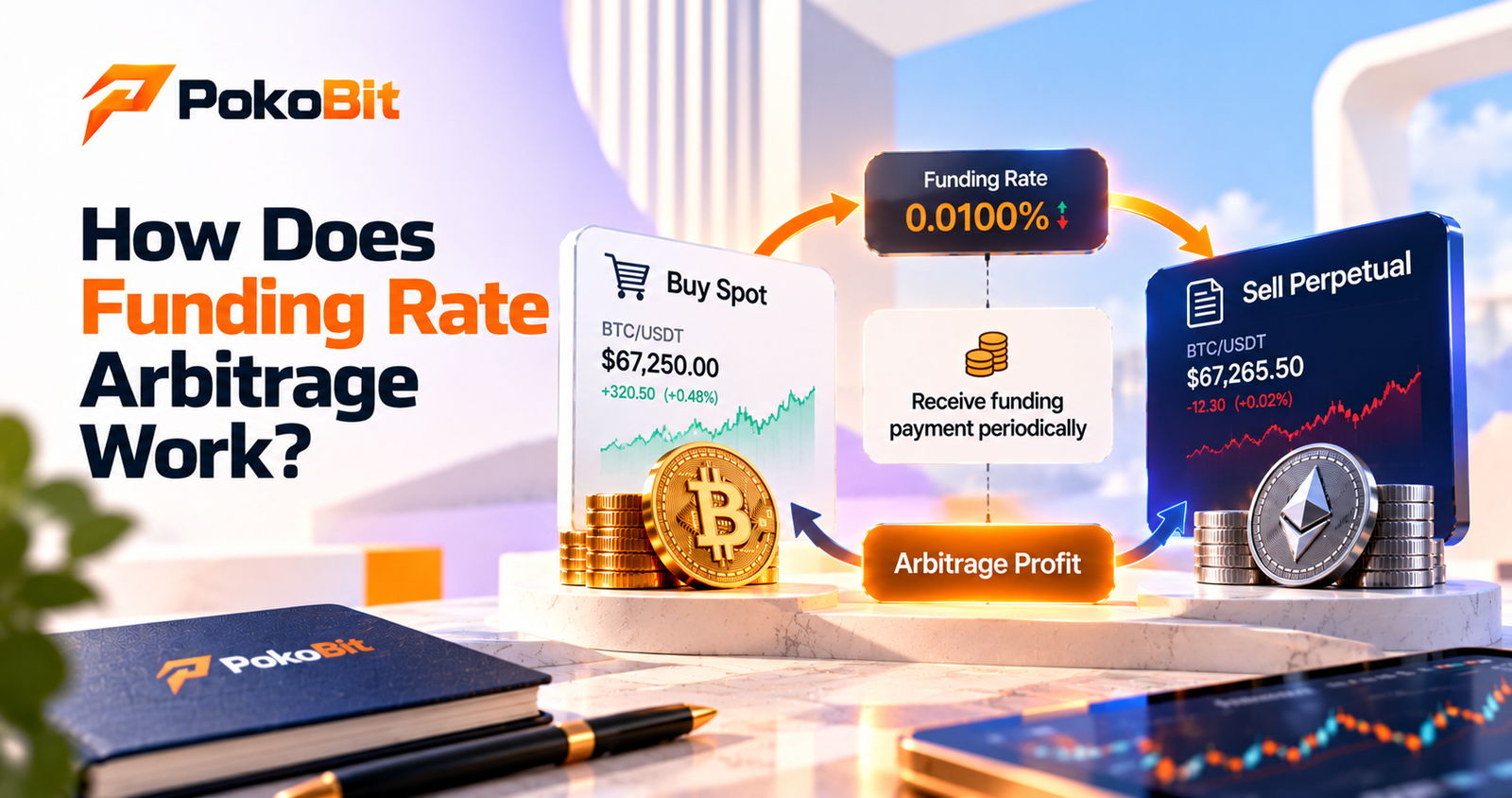
A simple funding rate arbitrage setup can involve buying an asset in the spot market while taking an equivalent short position on a perpetual futures contract.
The trader's goal is not necessarily to profit from Bitcoin or another cryptocurrency going up or down. Instead, the focus is on the funding payments and the relationship between the two positions.
What Is a Funding Rate?
A funding rate is a periodic payment exchanged between traders holding long and short positions in a perpetual futures market.
The payment is generally determined by the funding rate and the size of the position.
When the funding rate is positive, traders holding long positions typically pay traders holding short positions.
When the funding rate is negative, the direction of the payment generally reverses, with short-position holders paying long-position holders.
The exact calculation, payment interval and rules vary between exchanges and contracts.
How Does Funding Rate Arbitrage Work?
The basic strategy is relatively straightforward.
Suppose Bitcoin is trading at $100,000 in the spot market.
A trader could:
- Buy $10,000 worth of Bitcoin in the spot market.
- Open a $10,000 short position on a Bitcoin perpetual futures contract.
- Hold both positions.
- Receive funding payments if the applicable funding rate results in payments from longs to shorts.
- Close both positions according to the strategy's exit conditions.
The spot position gives the trader exposure to Bitcoin, while the short perpetual position provides an offsetting position.
If Bitcoin rises, the spot position can gain while the short position can lose.
If Bitcoin falls, the spot position can lose while the short position can gain.
The two positions are intended to offset much of the directional price exposure.
The potential return instead comes primarily from the funding payments, after accounting for trading costs and other expenses.
A Simple Funding Rate Arbitrage Example
Consider an illustrative example.
A trader has $10,000 available and buys $10,000 of Bitcoin on the spot market.
At the same time, the trader opens a $10,000 short position on a Bitcoin perpetual contract.
Assume the applicable funding rate is positive and the trader's short position is eligible to receive funding.
If the funding payment is 0.01% on a $10,000 position, the payment would be approximately:
$10,000 × 0.01% = $1
If the same rate applied over 10 funding payments, the gross funding received would be approximately $10.
This is only an illustration. Funding rates change over time, and the actual amount received depends on the exchange's funding calculation, payment schedule and position size.
Why Would Traders Pay the Funding Rate?
Funding rates exist primarily to help keep perpetual futures prices close to the underlying market.
When demand for long positions becomes stronger, the perpetual contract may trade at a premium relative to the spot market.
The funding mechanism can then make long positions more expensive to maintain and encourage traders to take the opposite side.
When the market becomes heavily skewed toward short positions, the funding mechanism can work in the opposite direction.
This creates a continuously changing environment where funding rates can move from positive to negative.
Positive vs Negative Funding Rates
Understanding the direction of funding payments is essential.
Positive Funding
When funding is positive, longs generally pay shorts.
A trader using the classic spot-plus-short-perpetual structure may therefore receive funding.
Negative Funding
When funding is negative, shorts generally pay longs.
In that situation, the same strategy could become less attractive because the short position may incur funding costs instead of receiving payments.
The strategy therefore depends on more than simply finding a perpetual contract with a funding rate.
The trader must understand which side pays and which side receives.
What Determines Funding Rate Arbitrage Profit?
The potential return is affected by several variables.
The most important include:
- Funding rate
- Position size
- Funding frequency
- Trading fees
- Spot price
- Futures price
- Slippage
- Liquidity
- Borrowing costs where applicable
- Withdrawal and transfer costs
- Margin requirements
A simplified estimate of funding income can be expressed as:
Funding Income = Position Size × Funding Rate
For example:
$20,000 × 0.015% = $3
But this is gross funding income for that funding event, not guaranteed net profit.
If the trader pays $1 in combined costs associated with execution, the net result would be different.
Why a High Funding Rate Can Be Misleading
A high funding rate may look attractive at first.
However, funding rates can change quickly.
For example, suppose a trader sees a funding rate of 0.05% and expects to receive funding consistently.
The rate could later fall to 0.01%, become zero or turn negative.
The trader could also face other costs while waiting.
This means funding rate arbitrage should be evaluated based on expected funding over the intended holding period rather than assuming that the current rate will remain unchanged.
Funding Rate Arbitrage vs Spot-Futures Arbitrage
Funding rate arbitrage and spot-futures arbitrage are closely related but not identical.
Spot-futures arbitrage can focus on the difference between the spot price and a dated futures contract.
Funding rate arbitrage generally focuses on perpetual futures and the funding payments between long and short traders.
For example:
Spot-futures arbitrage:
Buy spot and short a futures contract to potentially capture the basis.
Funding rate arbitrage:
Hold an offsetting position and attempt to collect favorable funding payments from the perpetual futures market.
Both strategies require careful analysis of costs and execution.
What Are the Main Risks?
Funding rate arbitrage can reduce directional exposure, but it is not risk-free.
Funding Rate Changes
The biggest consideration is that funding rates are variable.
A profitable funding environment can disappear or reverse.
Trading Fees
Opening and closing two positions creates trading costs.
If the funding received is small, fees can consume much of the potential return.
Slippage
Large orders or thin markets can result in execution prices that differ from the displayed market price.
Liquidation Risk
A futures position uses margin.
If the trader uses excessive leverage or fails to maintain sufficient margin, liquidation can occur even when the overall hedge is intended to offset the spot position.
Basis Risk
The spot and perpetual prices may not move perfectly together.
Temporary differences between the two markets can affect the combined position.
Exchange Risk
The strategy depends on the reliability of the trading platforms involved.
Outages, withdrawal restrictions, API problems and other operational issues can interfere with execution.
Capital Efficiency
A hedged strategy can require capital to be distributed between spot holdings and futures margin.
The return therefore needs to be considered relative to the total capital committed, not simply the funding payment on one position.
How Do Traders Calculate Funding Rate Arbitrage?
A basic workflow is:
- Identify perpetual contracts with funding rates that may be attractive.
- Check whether the funding rate is positive or negative.
- Determine which side receives the payment.
- Estimate the expected funding income.
- Calculate trading fees for opening and closing positions.
- Check liquidity and expected slippage.
- Consider margin and liquidation requirements.
- Monitor changes in the funding rate.
- Calculate the potential net return.
- Close the positions when the strategy's conditions are met.
This process can be performed manually, but automated systems can continuously monitor funding rates across multiple markets.
Can Funding Rate Arbitrage Be Automated?
Yes.
An automated system can monitor perpetual futures markets and compare funding rates across contracts or exchanges.
A basic automated workflow could:
- Collect current funding rates.
- Compare rates across markets.
- Estimate potential funding income.
- Subtract estimated trading costs.
- Check liquidity.
- Identify opportunities that meet a predefined threshold.
- Execute the required positions if the system is designed and authorized to trade.
- Monitor funding changes and position risk.
This is one reason funding rates are relevant to crypto arbitrage scanners and trading automation.
However, automation does not guarantee profitability. A bot can execute a strategy faster, but it can also execute an unfavorable trade if the underlying assumptions, market data or risk controls are wrong.
How Does PokoBit Relate to Funding Rate Arbitrage?
Funding rate arbitrage is part of the broader crypto arbitrage landscape because it involves identifying differences in pricing or market conditions and evaluating whether they can potentially be exploited after costs.
For traders researching automated crypto arbitrage opportunities, PokoBit provides a platform focused on identifying and analyzing arbitrage opportunities.
The important distinction is that a displayed opportunity should not automatically be treated as guaranteed profit.
Traders still need to consider fees, liquidity, funding changes, execution and other risks before acting.
Conclusion
Funding rate arbitrage is a strategy that attempts to earn from favorable funding payments in perpetual futures markets while using an offsetting position to reduce directional exposure.
The classic approach involves buying an asset in the spot market and shorting an equivalent perpetual futures position when the funding environment is favorable.
The potential return comes primarily from funding payments, but those payments are not fixed. Funding rates can change, reverse or become too small to justify the costs involved.
For this reason, funding rate arbitrage should be evaluated using expected net returns rather than simply looking for the highest funding rate available.