
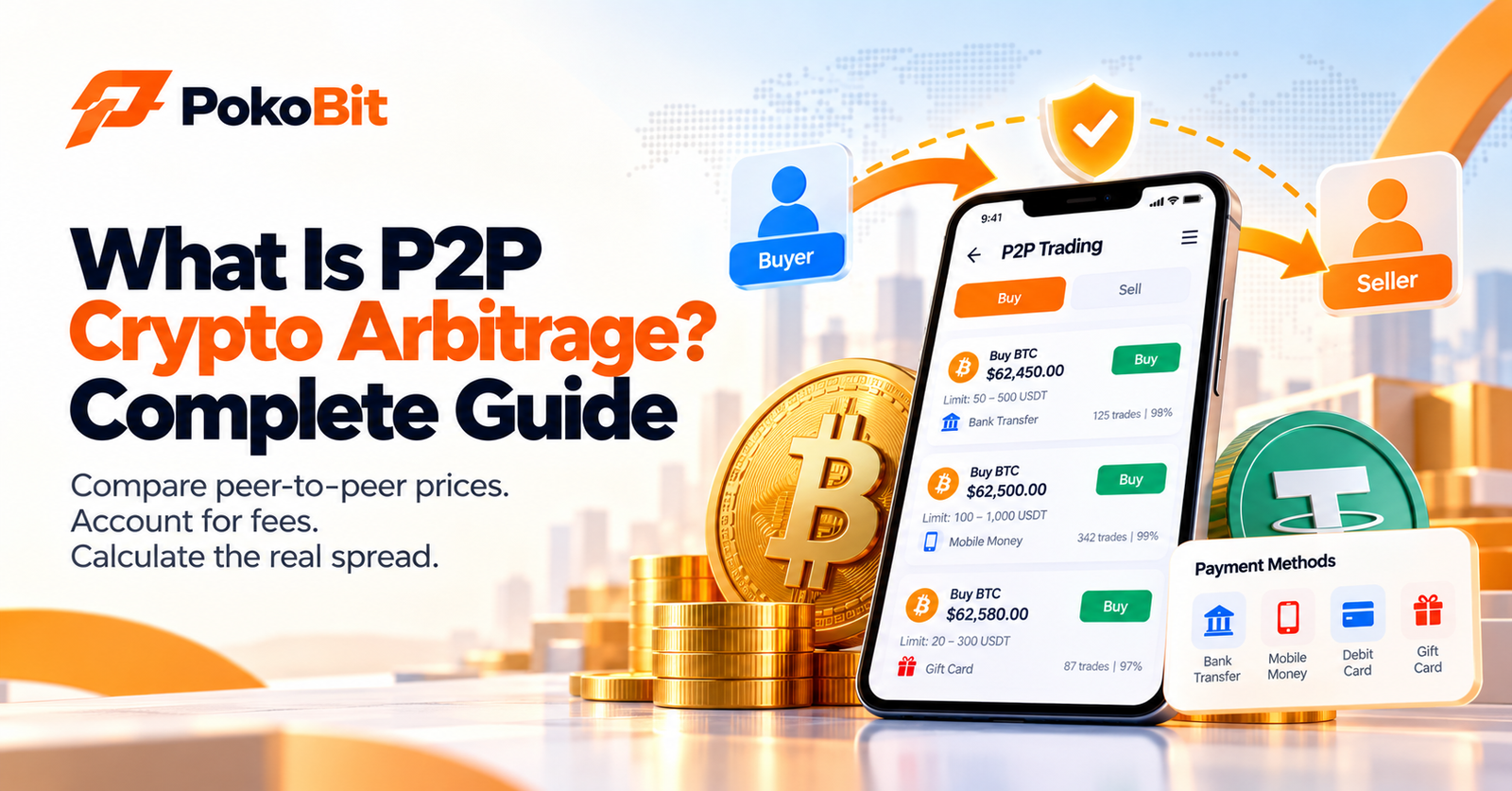
What Is P2P Crypto Arbitrage?
P2P crypto arbitrage is a strategy where traders look for price differences for the same cryptocurrency across peer-to-peer markets.
The basic idea is to buy cryptocurrency at a lower effective price and sell it at a higher effective price.
For example, a trader may find USDT available for ₦1,500 on one P2P market while another market has buyers willing to pay ₦1,530.
The apparent difference is ₦30 per USDT.
However, the ₦30 difference is not automatically profit. The trader must consider transaction fees, liquidity, payment costs, slippage, exchange restrictions, and other execution costs.
How Does P2P Crypto Arbitrage Work?
P2P arbitrage generally follows a simple process:
- Find a cryptocurrency price difference.
- Identify where the asset can potentially be bought more cheaply.
- Identify where it can potentially be sold at a higher price.
- Calculate the gross spread.
- Subtract all applicable costs.
- Determine whether the remaining potential profit justifies the execution risks.
For example:
Buy price: ₦1,500 per USDT
Sell price: ₦1,530 per USDT
Difference: ₦30 per USDT
For 1,000 USDT, the gross difference would be:
₦30 × 1,000 = ₦30,000
That ₦30,000 is a gross spread, not guaranteed profit.
Why Do P2P Crypto Prices Differ?
P2P platforms connect buyers and sellers directly, and prices can vary based on market conditions.
Price differences can be caused by:
- Supply and demand
- Available liquidity
- Payment methods
- Merchant pricing
- Fiat currency conditions
- Trading volume
- Market volatility
- Local demand for cryptocurrency
This can create temporary differences between P2P markets.
P2P Arbitrage Example
Imagine a trader sees the following prices:
P2P Market A: Buy USDT at ₦1,500
P2P Market B: Sell USDT at ₦1,530
The apparent spread is:
₦30 / ₦1,500 = 2%
If the trader could execute 2,000 USDT at those exact prices, the gross spread would be:
2,000 × ₦30 = ₦60,000
But suppose the trader incurs ₦25,000 in combined fees, payment costs, slippage and other expenses.
The potential remaining result would be:
₦60,000 − ₦25,000 = ₦35,000
This is an illustration rather than a guaranteed return.
What Is the Difference Between P2P Arbitrage and Regular Trading?
Regular crypto trading generally involves trying to profit from price movements.
P2P arbitrage focuses specifically on price differences between markets or trading venues.
A trader using arbitrage is not necessarily predicting whether Bitcoin or USDT will rise or fall. Instead, the strategy is based on identifying a price discrepancy and attempting to capture the difference.
However, price movement can still create significant execution risk.
What Costs Affect P2P Arbitrage?
The most important costs to consider include:
Trading Fees
Some platforms charge fees for specific P2P transactions or related trading activity.
Payment Costs
Banking or payment charges can reduce the spread.
Withdrawal Fees
Moving cryptocurrency between platforms may involve withdrawal fees.
Network Fees
Blockchain transactions can involve network fees depending on the asset and network.
Slippage
The available price may change when you attempt to execute a larger order.
Liquidity
A market may advertise an attractive price but have insufficient volume to execute your desired amount.
P2P Arbitrage Risks
P2P arbitrage is not risk-free.
Important risks include:
- Price changes
- Low liquidity
- Counterparty risk
- Payment delays
- Platform restrictions
- Account reviews
- Withdrawal limitations
- Fraud attempts
- Slippage
- Transfer delays
Traders should use established platform procedures and carefully verify payment and transaction details before releasing assets.
How to Find P2P Arbitrage Opportunities
A trader can compare P2P markets manually or use software that aggregates market information.
Look for:
- Large enough price differences
- Sufficient trading volume
- Reliable payment methods
- Competitive fees
- Fast settlement
- Adequate liquidity
The goal is not simply to find the largest spread.
The goal is to find a spread that remains potentially profitable after all costs and execution risks.
Is P2P Crypto Arbitrage Profitable?
P2P arbitrage can create potential trading opportunities, but profitability is not guaranteed.
A displayed spread may disappear before the trade is completed.
For example, a 2% spread may appear attractive, but after fees, slippage, payment costs and price changes, the actual result could be much smaller—or negative.
Therefore, traders should calculate the net potential result before executing a transaction.
Final Thoughts
P2P crypto arbitrage is based on identifying price differences between peer-to-peer cryptocurrency markets.
The concept is straightforward, but successful execution requires more than finding two different prices.
Traders need to consider liquidity, fees, payment methods, slippage, settlement time and market movements.
The most important rule is:
A P2P price difference is an opportunity to investigate, not guaranteed profit.
PokoBit can help users research cryptocurrency price differences and understand the factors that affect potential arbitrage opportunities.
Frequently Asked Questions
What is P2P crypto arbitrage?
P2P crypto arbitrage involves identifying price differences for the same cryptocurrency between peer-to-peer markets and evaluating whether the difference can potentially cover all trading and execution costs.
How does P2P arbitrage make money?
The strategy attempts to capture the difference between a lower effective purchase price and a higher effective selling price.
Is P2P crypto arbitrage risk-free?
No. Price movements, liquidity, fees, payment issues, counterparty risk and platform restrictions can all affect the outcome.
What cryptocurrency can be used for P2P arbitrage?
USDT is commonly analyzed in P2P markets, but other cryptocurrencies can also have price differences depending on liquidity and market conditions.
Does a larger P2P spread always mean more profit?
No. A large spread may come with low liquidity, high fees or significant execution risks.