
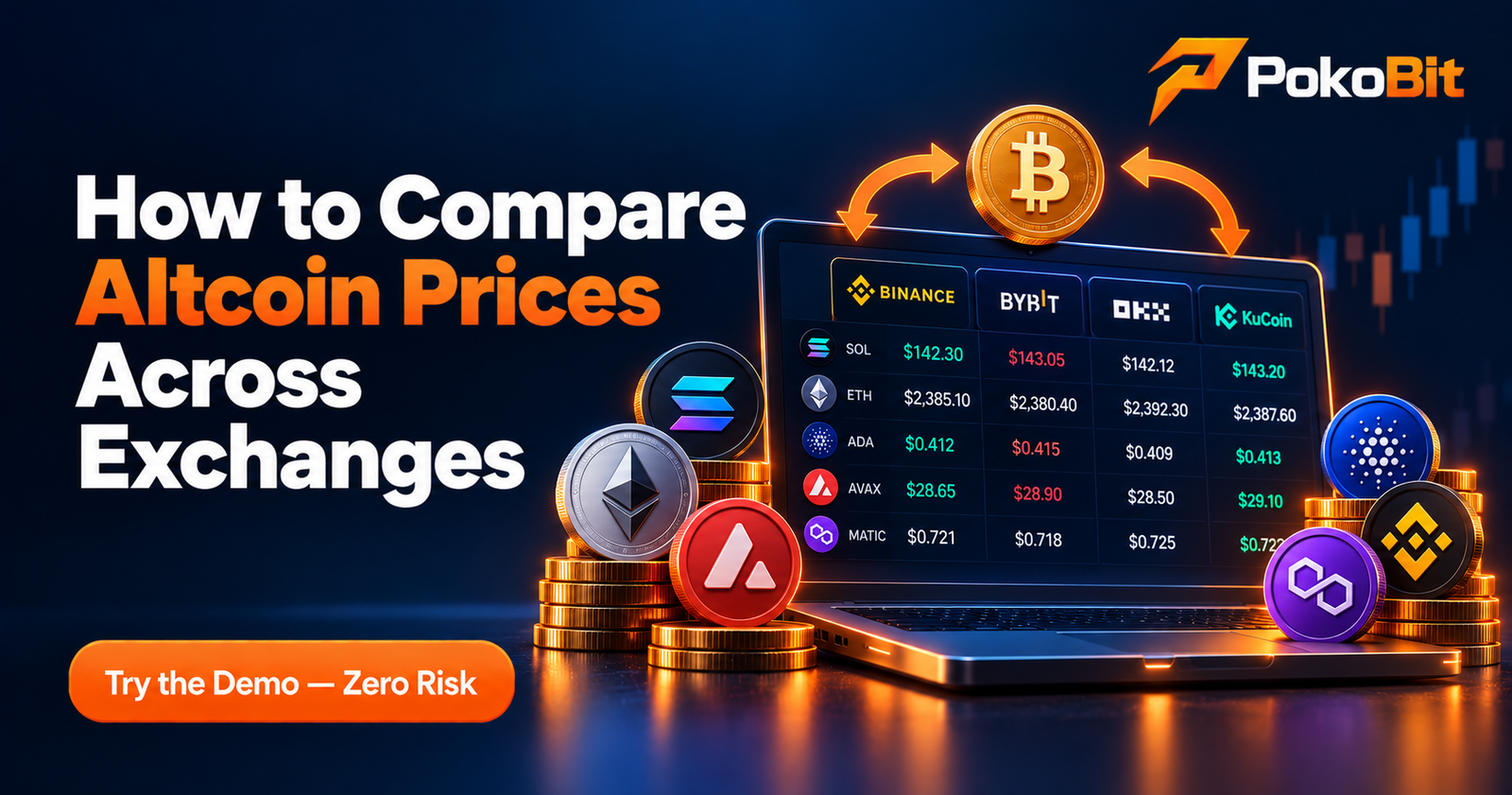
How to Compare Altcoin Prices Across Exchanges
Altcoin prices can differ slightly between cryptocurrency exchanges because each platform has its own order flow, liquidity, trading activity and market participants.
For traders interested in arbitrage, these differences can be worth monitoring.
The basic idea is simple: find an altcoin trading at a lower effective price on one exchange and a higher effective price on another.
However, comparing the displayed prices alone is not enough.
The actual opportunity depends on the bid and ask prices, order-book depth, trading fees, slippage, trade size and other execution costs. Binance’s current trading-analysis guidance similarly emphasizes that the visible price can differ from the actual execution cost once liquidity, order-book depth and fees are considered.
Why Do Altcoin Prices Differ Across Exchanges?
Cryptocurrency markets are fragmented.
An altcoin can have thousands of buyers and sellers distributed across different exchanges. Because these participants do not all trade at exactly the same time or at the same prices, temporary differences can appear.
Some of the factors that can contribute to price differences include:
- Market demand
- Trading volume
- Liquidity
- Order-book depth
- Regional activity
- Market volatility
- Different exchange user bases
- Trading fees
- Large buy or sell orders
These differences can create potential arbitrage opportunities, although the spread may disappear quickly.
Step 1: Choose the Altcoin
Start by selecting the altcoin you want to compare.
For example:
- SOL
- XRP
- DOGE
- ADA
- AVAX
- LINK
- SUI
- NEAR
The particular asset matters because liquidity can vary significantly between cryptocurrencies.
A market with strong liquidity may be easier to trade than an altcoin with a large headline spread but very little order-book depth.
Current CoinGecko research emphasizes that liquidity depth can be more useful than trading volume alone when evaluating how easily a trade can actually be executed.
Step 2: Compare the Same Trading Pair
Make sure you are comparing the same market.
For example:
SOL/USDT on Exchange A
with
SOL/USDT on Exchange B
You should not compare SOL/USDT on one platform with SOL/NGN on another without accounting for the currency conversion and other market differences.
Using the same quote currency makes the comparison much cleaner.
Step 3: Look at the Ask Price When Buying
If you want to buy an altcoin, the relevant figure is generally the ask price.
Suppose:
Exchange A: SOL ask = $150.00
Exchange B: SOL ask = $151.20
If you are looking to buy SOL, Exchange A appears cheaper.
But don’t stop there.
You need to check whether enough SOL is actually available around $150.
Step 4: Look at the Bid Price When Selling
When comparing where you could sell, look at the bid price.
Suppose:
Exchange A: SOL bid = $149.90
Exchange B: SOL bid = $151.10
A trader considering arbitrage would potentially look at buying SOL around $150.00 on Exchange A and selling around $151.10 on Exchange B.
The apparent difference is:
$151.10 − $150.00 = $1.10
That is the starting spread—not guaranteed profit.
Step 5: Check the Order Book
This is one of the most important steps.
Imagine an exchange shows:
SOL ask: $150
But there are only 2 SOL available at that price.
If you want to purchase 500 SOL, most of your order may execute at higher prices.
This is why the top-of-book price can be misleading for larger orders.
A real comparison should examine the order book level by level and determine the expected average execution price for your actual trade size. Binance’s current trade-analysis tool uses this approach, including order-book depth and VWAP-style execution analysis.
Step 6: Enter Your Intended Trade Size
Your trade size can completely change the comparison.
For example:
Trade A: $100
Trade B: $10,000
The same altcoin may appear equally attractive for both trades, but the larger order can experience more price impact if liquidity is insufficient.
This is why you should compare exchanges using the amount you actually intend to trade, rather than assuming the best displayed price applies to every order size.
Step 7: Calculate the Effective Price
The effective price is more useful than the headline price.
A simplified calculation is:
Effective Buy Cost = Execution Cost + Applicable Fees
For a sale:
Effective Sell Proceeds = Execution Proceeds − Applicable Fees
You can then compare the effective buying cost with the effective selling proceeds.
This gives you a more realistic picture of the potential spread.
Step 8: Account for Trading Fees
Every exchange has its own fee structure.
Your comparison should account for:
- Buy-side trading fee
- Sell-side trading fee
- Maker/taker status
- Account-specific fee tiers
- Any applicable discounts
Even a small difference in fees can matter when the arbitrage spread is relatively small.
Current crypto trading-analysis tools increasingly calculate exchange-specific fees alongside execution prices for this reason.
Step 9: Account for Slippage
Slippage occurs when your actual execution price differs from the price you expected.
For example:
Expected buy price: $100
Average execution price: $100.40
Your effective buying price is therefore higher than the headline quote.
For arbitrage, this can significantly reduce the spread.
Liquidity depth is particularly important because two exchanges can have similar trading volumes but very different order-book conditions.
Step 10: Calculate the Real Spread
Once you know the effective prices, calculate:
Potential Spread = Effective Selling Price − Effective Buying Price
For example:
Effective buy price: $100.20
Effective sell price: $101.00
Potential spread:
$101.00 − $100.20 = $0.80
If the trade size is 1,000 tokens:
$0.80 × 1,000 = $800
This is still a potential gross difference before any additional costs such as transfers or other applicable expenses.
Example: Comparing an Altcoin Across Three Exchanges
Imagine you are comparing an altcoin called XYZ.
| Exchange | Ask Price | Bid Price | Available Liquidity |
| Exchange A | $10.00 | $9.98 | High |
| Exchange B | $10.10 | $10.08 | Medium |
| Exchange C | $10.05 | $10.03 | Low |
At first glance, Exchange A appears to be the cheapest place to buy and Exchange B appears to be the best place to sell.
The apparent spread is:
$10.08 − $10.00 = $0.08
But you then need to check whether Exchange A has enough liquidity at $10.00 and whether Exchange B has enough buyers at $10.08.
If not, the actual spread could be much smaller.
Why Volume Alone Is Not Enough
A common mistake is to compare exchanges using only 24-hour trading volume.
High volume indicates that significant trading has taken place, but it does not necessarily tell you how much liquidity is available at the exact prices you need.
CoinGecko’s recent liquidity research specifically notes that trading volume and liquidity depth can tell different stories about execution quality.
For arbitrage, order-book depth is often more directly relevant to your actual trade.
Using an Altcoin Price Comparison Tool
Manually checking several exchanges can become difficult when monitoring many assets.
A price comparison or arbitrage scanner can automate much of the process.
A useful tool may show:
- Altcoin
- Trading pair
- Exchange
- Bid price
- Ask price
- Order-book depth
- Trading fees
- Spread
- Slippage
- Estimated effective price
- Potential net result
Some current crypto analysis tools simulate actual execution across multiple exchanges and update their comparisons using live order-book information.
Comparing Altcoin Prices for Arbitrage
A practical workflow is:
1. Select the altcoin.
2. Select the same trading pair across exchanges.
3. Compare ask prices for buying.
4. Compare bid prices for selling.
5. Check order-book depth.
6. Enter your intended trade size.
7. Calculate expected execution prices.
8. Deduct trading fees.
9. Account for slippage and transfer costs.
10. Calculate the remaining net potential spread.
Only after completing these steps should you decide whether the price difference is worth further consideration.
Common Mistakes When Comparing Altcoin Prices
Comparing Last-Traded Prices
The last traded price may not be the price available when you place your order.
Ignoring Bid and Ask Prices
For arbitrage, the price you can actually buy and sell at matters.
Ignoring Order-Book Depth
A displayed price may only be available for a small quantity.
Ignoring Trading Fees
A seemingly attractive spread can disappear after fees.
Ignoring Slippage
Large orders can move through multiple order-book levels.
Comparing Different Trading Pairs
Always make sure you are comparing equivalent markets.
Assuming the Spread Will Remain
Crypto markets move quickly. A price difference can disappear before both sides of the trade are executed.
Final Thoughts
Learning how to compare altcoin prices across exchanges is an important skill for anyone researching crypto arbitrage.
The process goes beyond opening two exchange websites and looking at the displayed prices.
A proper comparison should consider the same trading pair, bid and ask prices, order-book depth, trade size, liquidity, trading fees, slippage and other execution costs.
The biggest visible price difference is not necessarily the best opportunity.
The better question is:
“What price can I realistically buy at, what price can I realistically sell at, and what will remain after all costs?”
That is the comparison that matters.
Explore PokoBit
Explore PokoBit for more crypto arbitrage strategies, market insights and cryptocurrency trading resources.
Frequently Asked Questions
How do I compare altcoin prices across exchanges?
Choose the same altcoin and trading pair on multiple exchanges, then compare their bid and ask prices. After that, check order-book depth, trading fees, slippage and your intended trade size.
Should I compare the last traded price?
Not by itself. For a potential arbitrage trade, the current bid and ask prices are more useful because they indicate where orders may actually execute.
Why can the same altcoin have different prices?
Differences in liquidity, trading activity, order flow and market demand can cause temporary price differences between exchanges.
Is the cheapest exchange always the best place to buy?
No. The cheapest displayed price may have insufficient liquidity or may become more expensive once slippage and fees are included.
What is order-book depth?
Order-book depth shows the amount of buying and selling interest available at different price levels. It helps traders estimate how much an order may affect its execution price.
Can I automate altcoin price comparisons?
Yes. Price scanners, exchange APIs and arbitrage software can monitor multiple exchanges automatically. However, automated comparisons still depend on accurate and timely market data.
Does a price difference mean guaranteed arbitrage profit?
No. A visible price difference is only a potential opportunity. Fees, slippage, liquidity, transfer costs and rapid market movements can reduce or eliminate the potential return.