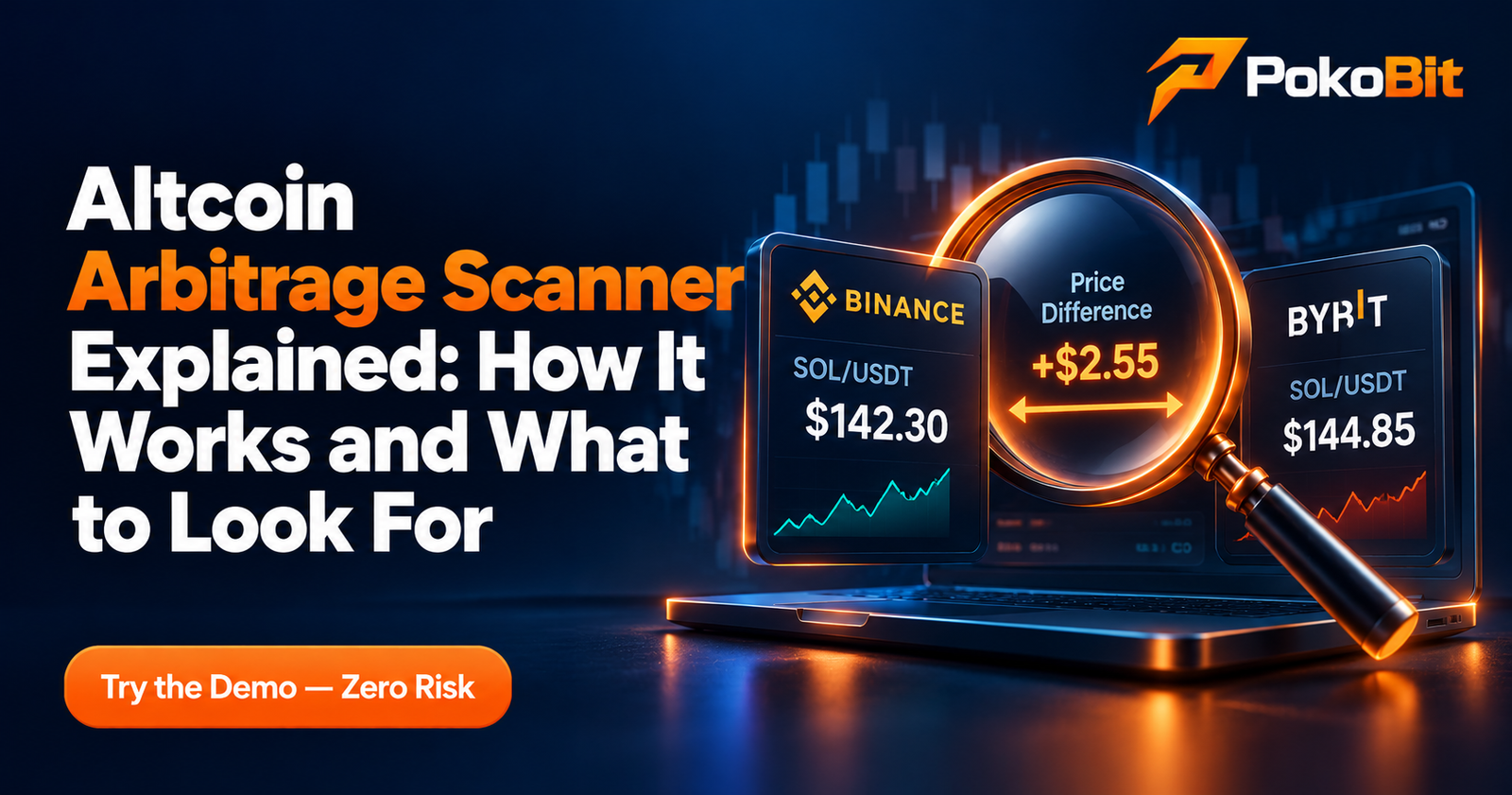
Altcoin Arbitrage Scanner Explained
An altcoin arbitrage scanner is a software tool that monitors cryptocurrency markets and searches for price differences involving altcoins across different exchanges.
Instead of manually checking the price of an altcoin on several platforms, a scanner can collect market data, compare prices and highlight potential arbitrage opportunities.
For example, suppose SOL is trading at $150 on one exchange and $151.20 on another. A scanner can identify the difference and alert the trader.
However, a visible price difference does not automatically mean there is a profitable arbitrage trade. Trading fees, liquidity, slippage, transfer costs and execution speed can significantly change the actual result.
What Is an Altcoin Arbitrage Scanner?
An altcoin arbitrage scanner is designed to find potential price discrepancies between markets.
It can monitor assets such as:
- SOL
- XRP
- ADA
- DOGE
- AVAX
- LINK
- SUI
- NEAR
- Other supported altcoins
Depending on the scanner, it may monitor centralized exchanges, decentralized exchanges, or both.
The primary purpose is to make it easier to identify price differences without manually checking every exchange.
How Does an Altcoin Arbitrage Scanner Work?
1. Collects Exchange Data
The scanner connects to supported exchanges and collects information such as:
- Bid prices
- Ask prices
- Trading pairs
- Order-book data
- Trading volume
- Liquidity
- Market prices
Real-time or frequently updated data is important because arbitrage opportunities can disappear quickly.
2. Compares Altcoin Prices
The scanner compares the same altcoin and trading pair across different exchanges.
For example:
Exchange A — SOL/USDT: $150.00
Exchange B — SOL/USDT: $151.25
The scanner identifies a $1.25 difference.
3. Calculates the Spread
The basic spread can be calculated as:
Spread = Selling Price − Buying Price
In this example:
$151.25 − $150.00 = $1.25
The scanner may also display the difference as a percentage.
But the displayed spread is only the beginning of the analysis.
4. Checks Liquidity
A good scanner should help traders understand whether enough of the altcoin is actually available at the quoted price.
For example, an exchange might show SOL at $150, but only a small amount may be available at that level.
A larger order could then execute at increasingly higher prices.
This is why order-book depth is important when evaluating arbitrage. Trading volume alone does not necessarily show how much liquidity is available at the exact prices required for a trade. (coingecko.com)
Why Order-Book Data Matters
Imagine a scanner detects:
Buy: $100
Sell: $102
The displayed spread is 2%.
But suppose only $500 worth of the asset is available at $100.
If you want to trade $10,000, your entire order cannot necessarily be executed at that price.
The average purchase price could become significantly higher.
This reduces the effective spread.
For this reason, advanced trading-analysis systems use order-book information and execution estimates rather than relying solely on the last traded price. (binance.com)
What Should an Altcoin Arbitrage Scanner Show?
A useful scanner should provide more than a list of price differences.
Altcoin
The scanner should identify the exact cryptocurrency being compared.
Trading Pair
For example:
SOL/USDT
Buy Exchange
The exchange where the asset may be available at the lower effective price.
Sell Exchange
The exchange where the asset may potentially be sold at the higher effective price.
Buy Price
The relevant ask price rather than simply the last traded price.
Sell Price
The relevant bid price.
Spread
The difference between the effective buy and sell prices.
Liquidity
The amount available around the relevant price levels.
Trading Fees
The scanner should ideally account for fees on both sides of the transaction.
Slippage
The expected impact of trade size on execution price.
Potential Net Result
This is much more useful than simply showing the largest gross spread.
Example of an Altcoin Arbitrage Scanner
Imagine a scanner displays:
| Asset | Buy Exchange | Buy Price | Sell Exchange | Sell Price | Gross Spread |
| SOL | Exchange A | $150.00 | Exchange B | $151.20 | 0.80% |
| XRP | Exchange A | $2.50 | Exchange C | $2.53 | 1.20% |
| ADA | Exchange B | $0.80 | Exchange A | $0.81 | 1.25% |
At first glance, ADA appears to have the largest spread.
But that does not necessarily make it the best opportunity.
The trader still needs to check liquidity, trading fees, slippage and whether the displayed prices are actually executable for the intended trade size.
Gross Spread vs Net Potential Profit
This is one of the most important concepts in arbitrage.
Suppose a scanner detects:
Buy: $10.00
Sell: $10.20
The gross spread is:
$0.20
If you trade 1,000 units:
Gross difference = $200
Now assume:
Trading fees: $50
Slippage: $60
Transfer costs: $20
Potential remaining amount:
$200 − $130 = $70
Therefore, the 2% displayed spread does not mean a 2% guaranteed return.
The actual potential result depends on the complete execution.
How an Altcoin Arbitrage Scanner Finds Opportunities
A scanner typically follows a process like this:
Collect market data → Compare exchanges → Identify price difference → Check liquidity → Estimate costs → Calculate potential net result → Generate alert
Some systems can perform these calculations continuously across hundreds or thousands of trading pairs.
That can make scanners particularly useful for traders who want to monitor many markets simultaneously.
Why Speed Matters
Crypto markets operate continuously.
An altcoin can move significantly within a short period, especially during periods of high volatility.
When an arbitrage opportunity appears, other traders and automated systems may act on the same price difference.
Their activity can cause the cheaper market to rise and the more expensive market to fall, reducing the spread.
This is why arbitrage is often highly dependent on execution speed. (binance.com)
A scanner helps by continuously monitoring markets instead of relying on manual price checks.
Altcoin Arbitrage Scanner vs Manual Checking
| Feature | Manual Checking | Scanner |
| Multiple exchanges | Difficult | Easier |
| Multiple altcoins | Difficult | Easier |
| Continuous monitoring | Limited | Possible |
| Price comparison | Manual | Automated |
| Alerts | Usually manual | Automated |
| Spread calculation | Manual | Automated |
| Liquidity analysis | Manual | Can be automated |
| Scalability | Low | Higher |
A scanner therefore acts as an opportunity discovery and market-monitoring tool.
How to Choose an Altcoin Arbitrage Scanner
Before using a scanner, consider the following.
Exchange Coverage
Does it support the exchanges you actually use?
Market Coverage
Can it monitor the altcoins and trading pairs you are interested in?
Data Speed
How quickly does it update prices and order-book information?
Liquidity Analysis
Does it consider order-book depth or only displayed prices?
Fee Calculation
Can it account for your actual trading fees?
Slippage Estimates
Does it consider your intended trade size?
Alerts
Can it notify you when a potential opportunity appears?
API Support
Can it integrate with exchange APIs if automation is required?
Security
If API keys are required, understand exactly what permissions the scanner needs.
Can an Altcoin Arbitrage Scanner Automatically Trade?
Some scanners are designed primarily for monitoring and alerts.
Others can connect to trading systems or exchange APIs and become part of an automated execution workflow.
This creates a distinction between:
Scanner: Finds potential opportunities.
Trading bot: Can potentially execute trades.
A scanner does not need to place orders to be useful.
Many traders may prefer to use the scanner to identify opportunities and then make the final execution decision themselves.
Risks of Using an Altcoin Arbitrage Scanner
A scanner can improve market monitoring, but it does not eliminate risk.
Stale Data
A price may change before the scanner updates.
Liquidity Risk
The displayed price may not be available for your entire order.
Slippage
The actual execution price can differ from the displayed price.
Trading Fees
Fees can reduce the potential margin.
Transfer Delays
If assets need to move between exchanges, the arbitrage spread may disappear before the transfer is completed.
Technical Problems
API failures, exchange outages or software errors can interrupt the process.
False Opportunities
A large displayed spread may exist because of low liquidity or unusual market conditions rather than a genuinely executable opportunity.
Can an Altcoin Arbitrage Scanner Guarantee Profit?
No.
An arbitrage scanner identifies potential opportunities. It does not guarantee that those opportunities will remain profitable when executed.
The spread can disappear, liquidity can change and execution costs can be higher than expected.
A scanner should therefore be treated as a tool for finding and evaluating opportunities, not as a guaranteed-profit system.
Final Thoughts
An altcoin arbitrage scanner can make it much easier to monitor cryptocurrency markets and identify potential price differences across exchanges.
The most useful scanners go beyond simply displaying the cheapest and most expensive prices.
They help traders consider bid and ask prices, order-book depth, liquidity, trading fees, slippage and potential net results.
The key lesson is simple:
The biggest displayed spread is not necessarily the best arbitrage opportunity.
The better opportunity is the one where the price difference can potentially survive real-world execution costs.
Explore PokoBit
Explore PokoBit for more crypto arbitrage strategies, market insights and cryptocurrency trading resources.
Frequently Asked Questions
What is an altcoin arbitrage scanner?
An altcoin arbitrage scanner is a tool that monitors cryptocurrency exchanges for price differences involving altcoins and identifies potential arbitrage opportunities.
How does an altcoin arbitrage scanner work?
It collects market data from supported exchanges, compares prices, evaluates spreads and may analyze liquidity, fees and other factors before generating an opportunity alert.
What is the difference between an arbitrage scanner and an arbitrage bot?
A scanner primarily identifies and monitors potential opportunities. An arbitrage bot can go further by automatically executing trades according to predefined rules.
Does an arbitrage scanner guarantee profit?
No. A scanner only identifies potential opportunities. Market movements, fees, slippage, liquidity and execution delays can affect the final result.
What should I look for in an altcoin arbitrage scanner?
Look for reliable market data, broad exchange coverage, order-book information, liquidity analysis, fee calculations, slippage estimates and timely alerts.
Can scanners compare hundreds of altcoins?
Some scanners can monitor a large number of trading pairs simultaneously, depending on their exchange coverage and technical architecture.
Is a bigger arbitrage spread always better?
No. A large spread can be caused by low liquidity or poor execution conditions. The potential net result after costs is more important than the displayed spread.